
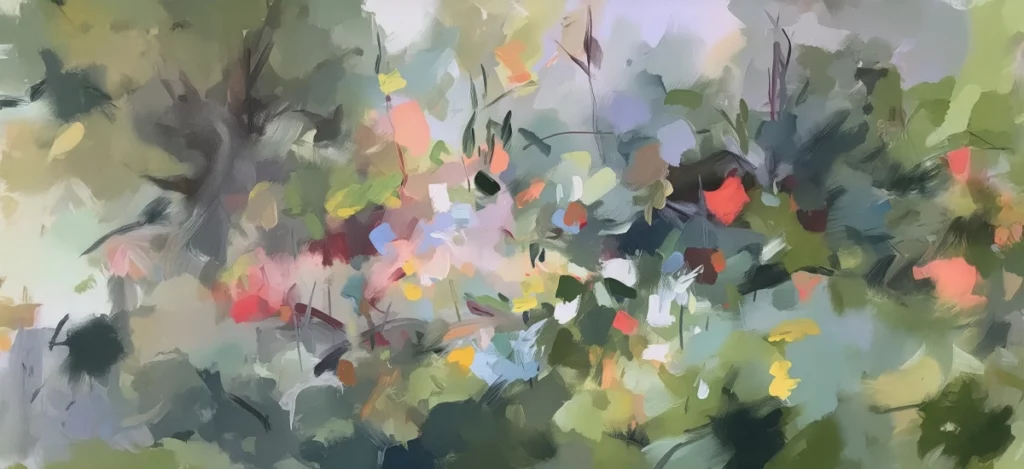

The Yoga of Gardening
At the time of writing, the countryside of Western Massachusetts is at its peak of late-spring bloom, a thousand shades of green and gold starred with flowers in every possible color. I have spent the last three weeks here digging in the dirt of my mother’s garden: planting bushes and groundcover, pulling out weeds, and moving plants that are doing poorly to a new location.
In such a big garden, there’s always a lot to do, and yet also a lot of space for contemplation. While pruning and planting, weeding and watering, I can’t help but notice how the simple act of caring for a garden illuminates so many aspects of spiritual life and practice.
Weeding Wisdom
For such a nurturing activity, there is a lot of destruction involved in gardening. If you haven’t cared for a garden before, you might be shocked to observe the rate at which weeds of all types sprout up among your chosen plants. They seem to grow back faster than you can pull them out!
You think that letting a few stay won’t be a problem, but those few will spread and spread. Some weeds are polite, but others will send creepers across the ground and climb over other plants until they choke them out. They take water and nutrients from the soil; some will even send toxins through their roots to kill their competition.
So you must be constantly vigilant, not only for the sake of aesthetics but to protect the plants in your charge.
The funny thing about weeds is that they’re just plants growing somewhere you don’t want them. There’s no inherent difference between that dandelion or garlic mustard you hunt down with a vengeance and those prized epimediums you’re so happy to see spreading through your beds.
In this way, plants are much like our patterns and tendencies: all are essentially equal, but we can choose which to cultivate and which to weed out. It doesn’t mean your fear, anger, attachments, or anything else are wrong or shouldn’t be there. They are also expressions of the Heart, albeit indirect ones, that usually bring more concealment and separation.
But while seeing yourself as you are, accepting yourself as you are, and loving yourself as you are, you can choose to cultivate the aspects of yourself that are more harmonious—direct expressions of the Heart, which resound with love, truth, and beauty.
The balancing act is to do this while never denying or rejecting those other aspects. They represent a path you choose not to follow, which you can do while still acknowledging their validity within the greater tapestry of existence.
As Many Monks, So Many Paths
Every plant needs a unique combination of factors to help it grow.
Some plants are in love with the sun, from morning to evening. Even a slight shadow will keep them small and sparse.
Others wilt with too much exposure. They prefer indirect light under the shelter of another plant or light shade filtered through tall trees or sun only for a few hours per day.
Some plants like to drink deep and then dry out. Others want constant moisture.
Some like rich, dark soil, while others would rather grow amid sand and rocks.
Some thrive when cut back at the beginning of the season, focusing their energy on fresh growth, while others would die from such drastic pruning.
In the same way, no two human beings are alike, and we each need different conditions to help us grow.
Some people learn the most through meditation, others through Hatha Yoga, and others through selfless service. Some blossom in devotion, others through purely witnessing. Some need a lot of guidance from teachers or support from community, while others prefer to find their own way.
Each of us has led unique lives that have shaped us to approach the Truth through different gateways and to reflect different facets of it.
Kashmir Shaivism describes the creative will of Shiva as svatantrya, “self-dependent,” meaning that it acts only according to its own freedom. The Infinite is not lacking anything that would cause it to manifest the world of form—it chooses to do so out of pure joy.
And so the mere fact that you appear as you do is because Shiva wants to experience Himself through that particular expression.
This divine manifestation of your body and personality is unique. In the infinity of the Universe, there never has been and never will be one exactly like it. Whatever you like or don’t like about yourself, you are a sacred work of art just the way you are. Only a failure to recognize this would cause you to judge yourself against others, to say that you should be more like this or that just because someone else is.
The path is already laid out before your feet. Only you can walk it, and you cannot walk the paths of others.
Directing the Energy
Working with plants is mostly about learning how to redirect their energy.
Plants receive a certain amount of energy from their environment, and they expend it by growing. The more they grow, the more energy they need to maintain themselves, but also, the more they can absorb through their new roots and leaves.
They can also grow in counter-productive ways: spindly shoots that take more energy to put out than they bring in or crossed tree branches that will eventually damage their bark.
You can always let them run wild and hope for the best, but to coax them into their biggest and most beautiful form, you gently manipulate the circumstances to redirect their efforts.
Looking at your life as a whole, where are you directing your energy? Are you focused and centered, or letting yourself be dispersed in many directions? Are you giving the best of yourself to the things you really care about?
Often, we make life so complicated that we end up putting most of our time and attention into aspects that aren’t the most fulfilling to our souls. Family or society tells us that certain things are important, so we prioritize these at the expense of what our hearts are calling for if only we were quiet or courageous enough to listen.
You don’t necessarily need to drop everything, but still, periodically look at the shape of your life and see what can be trimmed away to give more nourishment to those more profound dimensions of your being.
Karma Yoga in the Garden of the Soul
A garden is never finished. It is alive, which means it is in constant flux. You will never get to the point when you can step back, put it in a frame, and hang it on your wall. (You are the same way: there’s no perfect version of yourself out there that you will eventually attain. The only thing that does not change is Consciousness. As long as there is karma for a body, there is growth and change.)
As soon as you stop working on your garden, it will start to revert to nature.
If you aren’t aware of this, caring for a garden can become very frustrating. But if you are, it becomes a joy to release any notion of goal or endpoint and simply enjoy the process. You flow with the garden through its seasons as it takes on new shapes.
The work is the reward in itself when done with awareness, in the joy of the present moment, and with detachment from the outcome.
Every new plant you put in the ground is a hope for the future but not a guarantee. Your work is a creative collaboration between a human being and nature, with countless forces beyond your control that could cause failure, but you try anyway.
You can’t make a plant grow, but you can provide the best conditions for it.
You are the gardener of your soul. Although it may appear wild and overgrown, your inner domain is filled with beauty and wonders yet undiscovered. With proper cultivation, it can become a refuge of light and joy, available at all times and with an open door going beyond time altogether.
While it’s not for you to control all the turnings of your life, or to choose how your spiritual path unfolds, find what makes your heart blossom and offer that to yourself as best you can. Life itself—that womb of creation in which the spark of Consciousness germinates, bringing all beings to realization—will take care of all the rest.
Naveen is a Hridaya teacher and a frequent contributor to our blog. You can read all of her posts here.