
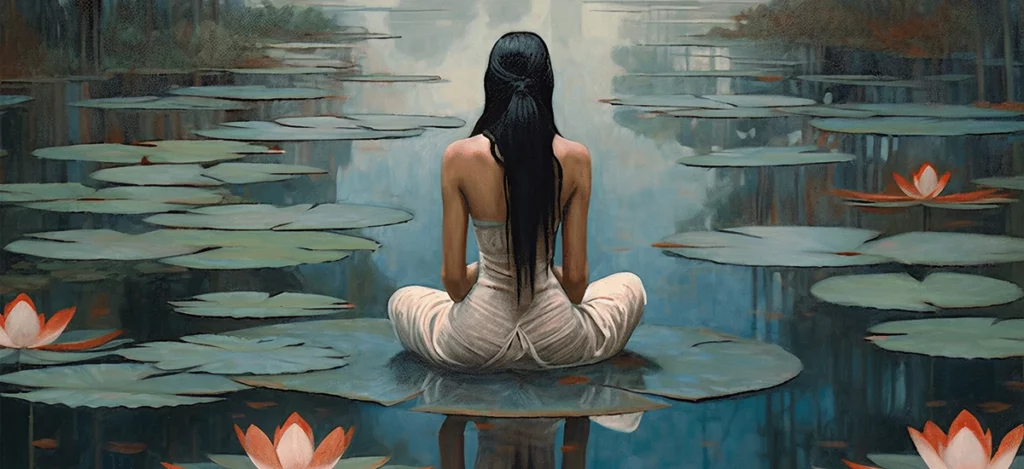

Nothing is accomplished without concentration. Multitasking usually means doing several things badly simultaneously and taking longer than if you were to do each task one at a time with your full attention.
The power of a concentrated mind is formidable. It can accomplish nearly anything.
There’s also a joy in concentration. I vividly remember practicing my violin scales and études as a teenager, mind and fingers united in microscopic focus while the rest of the world disappeared. Scales and études are not particularly exciting in themselves, but extreme concentration has a genuinely blissful quality. Normal awareness is shallow and a bit drab in comparison.
In any form of art, concentration allows you to progress in your technical skill and lends depth to your creations. It enables you to pierce through the veil of the ordinary.
Concentration elevates everything to art. Look in the eyes of anyone performing at the peak of their field, whether an elite ballet dancer, long-distance runner, mountain climber, or mathematician, and you will catch some hint of the sublime.
Concentration is also one of the qualities most endangered in modern society. Attention spans are in sharp decline. Social media, perfect mirrors for the “monkey mind,” encourage us to jump from screen to screen, to indulge in endless addictive scrolling, and to fill every moment with stimulation.
We have lost quiet, useless moments—waiting for the bus, riding the train, winding down before bed—that would give us space and respite from activity, just what we need to ferment new ideas or connect with the vibrance of simply being alive.
Holding the Mind on a Single Object
Concentration is a necessary ingredient for meditation—perhaps the most foundational.
Dharana is the sixth limb of Patanjali’s ashtanga yoga, the first of the “inner limbs.” In Yoga Sutras, he defines it thus:
“Concentration (dharana) is the process of holding or fixing the attention of mind onto one object or place, and is the sixth of the eight rungs.” (Yoga Sutras, 3.1)
Rather than jumping constantly from thought to thought, the mind in dharana is intentionally held to a single object—the single-pointed concentration referred to by Buddhists.
However, it is not that the mind is frozen or stopped, per se. The mind is inherently fluid. It functions much like a high-velocity flipbook or camera film, with images occurring in such rapid succession as to appear seamless.
When practicing dharana, you train the mind to regenerate the same image continuously.
Say you’re focusing on a candle flame. At first, your mind may fluctuate wildly. You may have only a few “frames” of true focus on the flame per dozens of unwanted images. But you keep looping back, inserting your object of concentration into your mental flow.
After a while, you can hold the flame steady in your mind for a few seconds and catch your wandering attention after only a few unrelated thoughts.
Finally, your mind offers the flame at every moment, so it appears as a stable object within your consciousness. Your attention might flicker away for a moment, but it immediately snaps back without any effort.
Training the Mind
Sometimes people will claim they can’t meditate because their mind is too noisy and they can’t concentrate. I cannot emphasize enough that concentration is a skill which can be developed, and must be—very few of us are born with the ability to hold single-pointed focus.
You can increase the mind’s capacity for focus through careful, gradual training, just like a muscle. (The process is outlined very beautifully in Buddhist teachings, which describe nine progressive stages of shamatha to be achieved before the practice of vipashyana or vipassana, insight meditation—turning the lens of the stabilized mind towards the nature of reality.)
The mind should never be approached with violence. It is, the Buddhists say, like a wild elephant: immensely powerful but dangerous if approached carelessly, and impossible to coerce.
You may be able to force some degree of concentration through sheer willpower. Still, a mind under pressure is liable to break out of containment sooner or later, and even while it is contained, you will not be able to pass from forced concentration into deeper meditative states, which require relaxation and surrender.
According to Xenophon, the ancient Greek philosopher and renowned equestrian, “What a horse does under compulsion he does blindly, and his performance is no more beautiful than would be that of a ballet dancer taught by whip and goad.”
The same could be said of the mind, the steed on which our awareness gallops through the world.
You will only progress in meditation if you learn to love it and taste its sweetness, which is not immediately apparent. Frustration with your mind, the old “I’m not good enough,” might lead you to give up before you get the taste.
Better is to train yourself through positive reinforcement. Rather than getting angry when you lose focus or going into some story about how your mind is so crazy and meditation is so difficult, try having a little moment of celebration whenever you catch yourself distracted and return your mind to your chosen object of concentration.
This will train your mind to self-monitor and come back whenever it starts to wander.
Remember that it is the natural tendency of the mind to wander, which you have reinforced. The mind has no “mind of its own;” it’s not out to make your life difficult. It’s only an instrument, and it reflects whatever patterns you have put into it.
Most of us have let our minds run wild for most of our lives. Learning to concentrate on a single object is a radical shift. It won’t happen overnight nor without some resistance. But as S.N. Goenka, the vipassana master, would say, “Work patiently and persistently. You are bound to be successful. Bound to be successful…”
Concentration Carries Us to Meditation
Still, concentration is not everything. It isn’t an end in itself. At a certain point, if you are interested in spirituality and not only the powers of the mind, you step into another flow.
“The repeated continuation, or uninterrupted stream of that one point of focus is called absorption in meditation (dhyana), and is the seventh of the eight steps.” (Yoga Sutras, 3.2)
Imagine that you have a nice little boat on the beach. You start pushing it toward the water. At first, it’s a lot of effort to get it moving through the sand, but you pick up momentum as you go. As the ground slopes down at the high tide line, you barely have to push at all to keep it sliding.
Then it’s picked up by the water, and you hop in; now, the boat carries you instead.
This is the transition from dharana to dhyana. Joy, naturalness, and fascination are the innate qualities of dhyana. The bottom drops out from under you and there is no longer any thought of focus or distraction, only a deep, calm, abiding contemplation of what is.
Single-pointed concentration has sliced laser-like through the occlusion of ordinary thinking, and now even that effort drops away.
You are free to sail on the ocean of wisdom, your mind’s eye opened inwards towards the source of awareness.
Naveen Radha Dasi is a Hridaya Yoga teacher and a frequent contributor to our blog. You can read all of her posts here.