

What Are the Chakras?

What Are the Chakras? The Sanskrit word chakra means “wheel” or “vortex,” and refers to the subtle gateways that allow universal energy to flow through our being. Each one represents a specific energetic frequency, from gross matter to spirit. As expressions of different levels of consciousness, they can be seen as stations on the spiritual […]
Yoni—Sacred Source

Yoni & Lingam Sacred Symbols of the Feminine and Masculine The word yoni means “holder,” “vagina,” “source,” or “womb.” According to Tantra Yoga, the yoni is the origin of life, the source of the Universe. It is associated with prakriti (the Universal Substance). In Hinduism, the yoni is a symbol of Shakti (the creative force […]
Yoga: Union with the Divine

Yoga Union with the Divine What Is Yoga? Attuning to the Seer Within A Tool to Reveal the Self The Sanskrit root yuj means to “yoke,” “bind,” or “join together.” It also indicates “union” or “Oneness.” At the deepest spiritual level, yoga allows us to reveal the Self, the True Essence of our Being. Ultimately, …
Yin and Yang—The Twofold Character of the Universe

Yin and Yang The Polar Energies In yoga, the word hatha is symbolically translated as ha (Sun) and tha (Moon). In this way, Hatha Yoga can be understood as the path of union between the solar and lunar energies within us. Similarly, in Taoism, yang is solar, masculine energy and yin is lunar, feminine energy…
Vak—The Eternal Word

Vak The Four Levels of the Word “In the beginning was the Word, and the Word was with God, and the Word was God.” –John 1:1, The Bible Vak or vac means “speech” and refers to the Eternal Word. In Eastern metaphysics, the creation of the Universe is often described in connection with the unfolding …
The Upayas

The Upayas The Means to Reveal Our Ultimate Nature In Kashmir Shaivism, upaya refers to the means to reveal our Ultimate Nature, Shiva Consciousness. The upayas unify the fettered soul with the Supreme. Shaivism asserts that there are three upayas (ways) that lead to this state: 1. Shambhavopaya or Icchopaya—The Means of Shiva Shambhavopaya is…
The Types of Kundalini Shakti

Three Types of Kundalini Shakti In Tantra Yoga, kundalini shakti is divided into three types according to the three fundamental levels of consciousness and existence—Shiva (absolute consciousness), Shakti (universal energy), and nara (the limited human being identified with his/her personality). The three corresponding aspects of kundalini are known as para kundalini, chit kundalini, and prana…
The Three Main Nadis
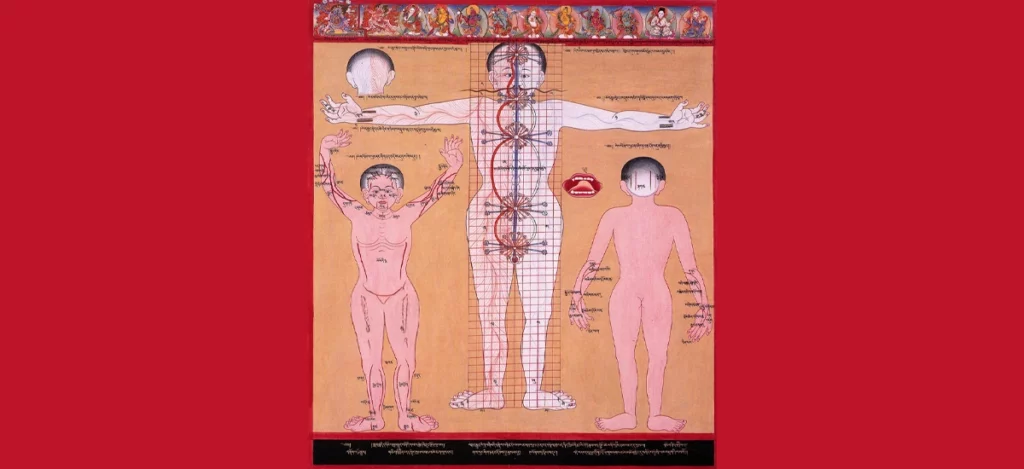
The Three Main Nadis Ida, Pingala, and Sushumna Nadis Convey the Life Force The Hatha Yoga tradition says that there are about 72,000 nadis (subtle channels of prana [energy]) that convey the life force in a human being. Ida, pingala, and sushumna are known to be the three principal nadis. The ending point of the…
The Three Kinds of Karma

The Three Kinds of Karma The Law of Cause and Effect The Three Kinds of Karma Karma means action, operating through the Law of Cause and Effect. It refers to the destiny that people make for themselves through their actions. According to the yoga tradition, there are three kinds of karma: prarabdha (that which is…
The Three Gunas—Sattva, Rajas, and Tamas

The Three Gunas Sattva, Rajas, and Tamas The Gunas—The Fundamental Qualities of Nature Guna means attribute, quality, strand. This word has many connotations, but the most common usage belongs to the vocabulary of the yoga and Samkhya traditions, where it refers to the well-known triad of forces—sattva, rajas, and tamas—that are thought to be the…
The Granthis—The 3 Psychic Knots

The Granthis The 3 Psychic Knots Granthis—Psychic “Knots” According to the yogic tradition, a granthi (“knot”) is an energetic and psychic contraction preventing the free flow of prana (energy) along sushumna nadi (the main energy channel in the subtle body). The granthis impede the awakening of the chakras and the rising of kundalini shakti (the…
Tantra Yoga The Yoga of Integrating Consciousness and Energy

Tantra Yoga The Yoga of IntegratingConsciousness and Energy Tantra Yoga—Seeing the Sacred in the Mundane The Sanskrit word tantra means “weaving” or “interconnection.” It comes from the root tan, meaning “to extend” or “to expand.” Although it only formally became relevant in the East after the fifth century A.D., Tantra Yoga (or Tantrism) is an…
Surrender Letting Go and Opening to the Self

Surrender Letting Go and Opening to the Self Surrender—Our Best Chance for Realization The human capacity to consciously let go of the ego and open to atman (the Supreme Self) is surrender, our main chance for Realization. If human beings were not endowed with the capacity to surrender, there would not be any chance to…
Somatization Infusing the Body with Spiritual Attitudes

Somatization Infusing the Body with Spiritual Attitudes Somatization—The Inner Cause of Disease This term “somatization” comes from the Greek “soma,” which means the physical body. Usually, when tensions, worries, internal conflicts, emotional turmoil, and stresses become chronic, they manifest as illnesses in the physical body that are labeled “psychosomatic.” Countless emotional tensions, conflicts, and mental…
Stillness Another Name for the Self

Stillness Another Name for the Self Stillness—The Background of Awareness Stillness refers to the background of awareness, a reality that is beyond duality, beyond positive and negative. It is another name for atman (the Supreme Self), the Spiritual Heart, the Witness Consciousness, our Real Nature. Therefore, it is not relative silence as opposed to noise…
Shatkarmas The Six Yogic Purification Practices

Shatkarmas The Six Yogic Purification Practices Shatkarmas—Practices for Purifying Body and Soul The first niyama, saucha, recommends performing cleanses for the internal organs and systems of the body. The shatkarmas or shatkriyas are the six traditional yogic practices (or groups of practices) that purify both the physical and subtle bodies. The Six Shatkarmas (Categories of…
Shaivism The Worship of Shiva

Shaivism The Worship of Shiva Shaivism—The Worship of Shiva as Transcendental Reality Shaivism is one of the main branches of Hinduism. It is the religious and philosophical tradition centered on the worship of Shiva as the transcendental Reality. Signs of the worship of Shiva dating from as far back as 2500 B.C. have been found…
Sat-Chit-Ananda Pure Existence-Pure Awareness-Pure Bliss

Sat-Chit-Ananda Pure Existence-Pure Awareness-Pure Bliss Sat-Chit-Ananda—The Essence of Brahman Sat-chit-ananda (also known as saccidananda and satchidananda) constitutes the very svarupa (essence) of Brahman (the Supreme Reality), not just Its attributes. This phrase suggests the unity of these three intrinsic expressions of the Absolute—they are not qualities, for Brahman is ultimately nirguna (unqualified) and akala (without…