
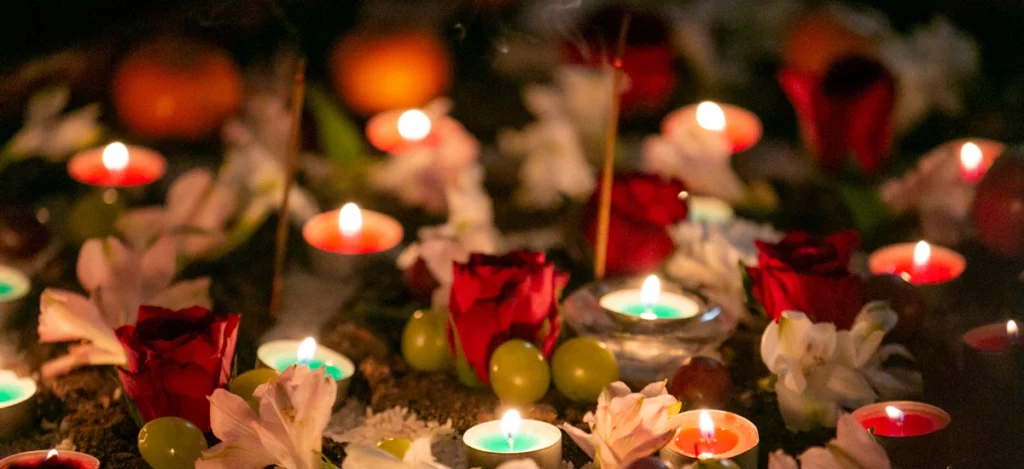

“This is a gathering of Lovers. In this gathering, there is no high, no low, no smart, no ignorant, no special assembly, no grand discourse, no proper schooling required. There is no master, no disciple. This is a gathering of Lovers.”
–Rumi
Bhakti Yoga is the path of devotion, its literal meaning being “mutual love” between the soul and the Beloved. Bhakti is like a sanctuary where our soul sings its songs of love, joy, and gratitude to the Divine. Bhajans, devotional songs, are the actualization of this inner music, a sacred expression of a soul’s deepest yearnings.
The practice of singing in Bhakti Yoga is deeply transformative. It purifies the heart, elevates the mind, and awakens us to our True Nature. Those who engage in bhajans with passion and surrender often have revelations and inner mystical visions.
In its purest form, singing bhajans is a devotional and transcendental encounter. Each chant is a whisper of our ache for union. When sacred vibrations open our hearts, we become one with the divine melody.
The Power of Sacred Sounds
Bhajans are much more than musical compositions and expressions; they can transform our hearts into vessels of divine energy—in fact, one of the meanings of the word bhajan in Sanskrit is “vessel.”
Nada Yoga teaches us that sacred sounds have the power to awaken our soul, carrying it into a realm beyond the physical and temporal. Here, every note, every word, is infused with causal cosmic energy, evoking an inner and outer harmony that transcends the material world, the Pythagorean “music of the spheres.” The mantras and sacred invocations of a bhajan are archetypal motifs, like milestones guiding our soul to the direct revelation of its oneness with the Divine.
We just surrender to the sounds, allowing our hearts to be carried away by their sacredness. Time and space dissolve, and only the bliss of Divine Presence remains.
Bhajans—A Realm of Consciousness
A session of bhajans is not just an event; it is a realm of consciousness. This mystical realm encompasses deep devotion, adoration, Self-awareness, simplicity, mutual harmony through singing, mantra chanting, sacred vibrations (nada), storytelling, bliss, dance, and many other pure emotional expressions.
It points directly to our True Nature, revealing harmony and Oneness.
The Musical Language of the Heart
While a bhajan’s inspiring melodies enchant the senses and mind, since their focus and content are divine, they free us from the confines of the senses and intellect. Transcending the limitations of ordinary language, its invocations and mantras are innocent expressions of love and surrender to the Divine.
Essentially, the meaning of a bhajan is not rational, but devotional. They are the utterances of a grateful heart singing in joy. Here, in the sacred space of bhajans, we discover the true language of the Heart.
The Breath of Our Soul
Just as aesthetic emotion, rasa, evokes a deep sense of beauty and unity in the one who perceives it, bhajans evoke the encounter and reconnection with the supreme beauty of the Heart. That’s why the songs aren’t bound by personal, transient emotions. Their creation and expression are rooted in the eternal presence of the Supreme Self. Bhajan invocations are the echoes of the eternal, charged with Divine Love.
Therefore, the songs we sing should be seen not as mere notes and rhythms. It’s not just about nice music or performance, but the breath of our soul seeking union with the Infinite, like wind whispering through the forest. As Rumi said: “Only the gentle breeze knows the secret of union. Listen as it whispers a song to every heart, like this….”
The Bliss of Divine Presence
In this state, we can taste the nectar of Divine Love, a rasa that surpasses all other experiences. This bliss is not dependent on external circumstances but arises directly from the Self. It is a state of grace, a gift that comes through surrender to the moment.
The Mystical Experience of Bhajans
Singing a bhajan is an act of deep vulnerability, revealing our soul’s most sensitive and beautiful dimensions in an intimate dialogue with the Divine. We share this with each other, becoming inspired by the reflections of Divine Light in the mirror of our souls. This is a conscious expansion, a science of surrender that evokes and is inspired by the devotion of great masters like Mira Bai, Saint Teresa of Ávila, Ramakrishna, Rumi, Rabia, and Ma Ananda Mayi.
And you? Why not? Be like such mystics! Singing bhajans is forgetting ourselves through love for God. This rasa (“taste” of the Divine) is the Heart’s most delicious gift to our soul.
Beauty, Universal Emotions, and the Dissolution of the Devotee
Just as the aesthetic experience of rasa can only be appreciated by those whose hearts are prepared to receive it, the sacred resonance of a bhajan touches the soul open to its holy melody. This preparation comes through the cultivation of devotion. In this way, our soul starts to attune to the divine vibrations that flow through sacred sounds, naturally uplifting our consciousness beyond personal borders.
In the devotional domain, beauty is not confined to the aesthetic qualities of sound or form; it’s a spiritual expression that transcends physical vibrations and the material world. The beauty of bhajans lies in their ability to evoke rasa, that deep, spiritual emotion that connects the soul with its eternal source. The sage Vishvanatha said this beauty is “compounded equally of joy and consciousness…”
Bhajans reveal the hidden beauty of the world, unveiling the divine presence within and around. As Wagner said, “What music expresses is eternal, infinite, and ideal.” Bhajans express universal emotions—Love, Adoration—addressed to the Universal Beloved, the Heart.
This transfiguration is not merely a change in perception but a dissolution of the perceiver; the soul expands and dissolves in the infinite love and grace of the Divine.
The Role of Transfiguration (Bhavana)
The appreciation of beauty, whether in nature, love, art, or bhajans, depends on the vibrant, transfiguring power of our heart, himma. It’s said that just as children playing with clay elephants infuse their play with life and meaning through their imaginations, devotees must bring their heartfelt emotions to the sacred sounds of bhajans.
Rabindranath Tagore observed that “those of the audience who are appreciative are content to perfect the song in their own mind by the force of their own feeling.” Therefore, it is our heartfelt engagement, sacred imagination, and emotional dedication that elevate the experience from mere listening with a critical mind to profound spiritual communion.
As Ananda Coomaraswamy states, “Pictures, poetry, and every work of art produce no effect save on souls prepared to receive them.” Similarly, the divine melody of bhajans touches the soul that is ready to embrace it, to surrender and trust in this mysterious new journey of love.
Speaking about images, the sage Shukracharya said, “The defects of images are constantly destroyed by the power of the virtue of the worshipper who has his heart always set on God.” This attitude may seem dangerously uncritical or not supportive of constructive feedback. Nevertheless, we should realize that it prevailed in all periods of great creative activity—and that the decline of humankind has always followed the decline of love and faith.
The Heart of Devotion and Creativity
When we sing and listen to bhajans, we are not merely performing or enjoying music—we are opening ourselves to Divine Grace.
Originality is not an intellectual endeavor but an alive revelation arising from bhakti. Creativity in bhajans is rooted in the innocent enthusiasm that radiates directly from the Heart. It frees us from fears and nervousness, transforming singing into devotion and devotion into singing.
Bhajans as an Essential Artform—Human Longing Addressed to the Gods
In ancient times, art was a kind of worship. We see this in the hymns of the Vedas, songs of praise, shamanic incantations, prayers, psalms, mantras, etc. Throughout history, conscious human beings have longed to express devotion through all the pores of their being, through all possible human means. Bhajans, in their essence, are acts of adoration that dissolve the ego and connect us to the Divine. They are a sacred offering of our soul to its essence. When we don’t feel devotion, we miss the truth of a bhajan; it becomes shallow, an ego looking for compensation. Being just a performer, involved only technically in artistic production, is ego-bound. To be a real devotee means looking for the Ultimate Truth; it means being free, spontaneous, and Self-aware. Bhajans, like any authentic artform, are beyond time, since they can carry the ineffable meaning that human souls will always recognize in wonderment and beauty. The taste of Truth and Love is always perceived by those living with an open soul, and it echoes eternally in Consciousness.
The Purity of the Worshipper
As traditional Indian art includes a master motif that unifies and to which all other expressions of emotion are subordinate, a bhajan requires a guiding force—our pure intention—to resonate and reunite with the Divine. When a heart sings with true devotion, the sounds become a manifestation of the Divine, a direct expression of the soul’s yearning for union with the Infinite.
Just as ritual offerings should always be sattvic, voices should always be harmonious. Rather than singing out of tune, it’s better just to murmur and interiorize the song. When our heart is set on God, the divine essence of the bhajan shines through, illuminating our soul and deepening our intimacy with the Divine.
The Transformative Power of Group Bhajans
By simply trusting and resting in the echoes of a session of bhajans, the Hridaya sangha can have an even deeper conscious shift towards bhakti. Patanjali said, “Supraconscious ecstasy is preceded by faith, inner power, evocation of such blissful states, and the knowledge brought by samadhi.” (Yoga Sutras, 1:20)
As in samadhi, any conscious, blissful state will be integrated and stabilized in our being if we meditate on its direct effects and the knowledge it brings to all domains of life. It’s an understanding and trust that this liberating, devotional potential can leave a deep imprint on our existence, like a royal seal. That intimacy and love, so obvious during bhajans, is always there.
Devotional singing in a bhajan or kirtan group transcends mere personal expression. It represents one of the most profound spiritual practices done in the intimate communion of the sangha. A deep friendship blossoms when sharing something ineffable, but of which we’ve all had quite a good taste. We unite with each other in that knowing. The depth of love in a sangha can be maintained by evoking this sense of divine Oneness, which is palpable during bhajans, meditations, and silent retreats.
To sing devotionally, “with our whole soul,” is to merge pure Love (Prema) with Beauty (genuine artistic expression). This isn’t merely about singing loudly to be heard by others or everyone doing what they want; it’s about consonance, creating a harmonious offering to the Divine together.
As the Islamic hadith says, “Indeed, God is Beautiful and loves beauty.” Beauty, as a tangible expression of Self-awareness, manifests in bhajans as humble devotion, harmony, freedom, and gratitude.
The Integration of Devotion and Self-Inquiry
The act of singing bhajans should lead to moments of deep inner stillness and peace, which are essential for effective Self-Inquiry.
Both deep meditative states and true art arise from complete stillness and openness to the ineffable, the sacred mystery of Being.
In the silence that follows each chant, we can touch the eternal, where all distinctions dissolve.
In this stillness, the question “Who am I?” can penetrate more deeply.
Ask “Who am I?” at the end of each song, when the energy has been intensely stirred, sublimated, and purified in love for God, the Spiritual Heart.
Devotional singing was an integral part of daily life at Ramana Maharshi’s ashram. Devotees would gather to sing hymns, including devotional hymns to Arunachala composed by Ramana. This confirms the harmonious relationship between bhakti and Self-Inquiry, a fusion of the adoration of the Beloved and non-duality, of bhakti and jnana, that is not very present in the Western mentality.
Bhajans can be in powerful synergy with Self-Inquiry. By opening our hearts and purifying the mind, bhajans create the proper conditions, a fertile ground, for Self-Inquiry and, ultimately, the revelation of the Spiritual Heart.
Let bhajans be your offering to the Divine.
Let these sacred chants resonate deeply within, until you wonder: “I am—no more. A song is all I am.”
Sahajananda is the main founder of Hridaya Yoga. You can read all of Sahaja’s posts here.