
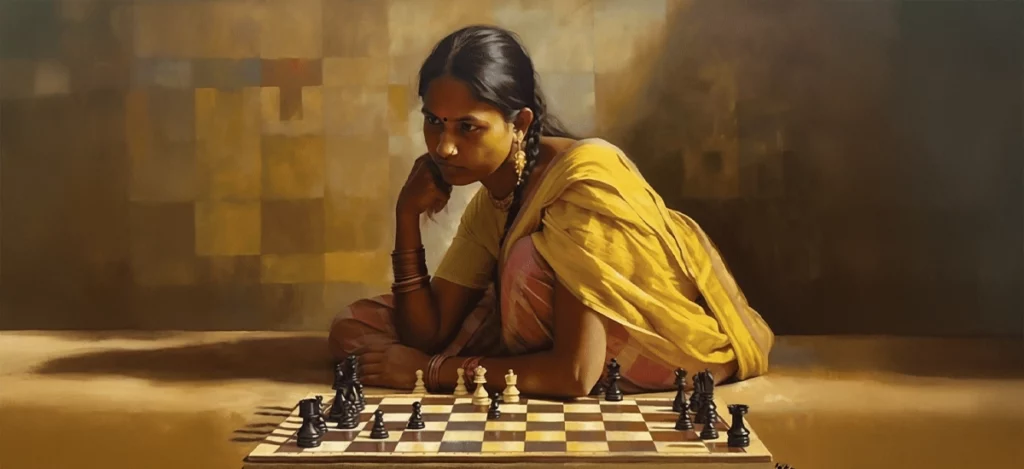

Holding onto the Saree: Faith and Surrender within the Beloved’s Chess Game
In an episode within the Mahabharata, Yudhisthira, the eldest of the five Pandava brothers, managed to lose his kingdom, his brothers, and their wife, Draupadi, in a dice game against a member of the enemy Kaurava clan.
The Kauravas took Draupadi to their court and demanded she act as their servant. When she refused, one Kaurava, Dushasana, tried to humiliate her by pulling off her clothes.
As a righteous woman on the side of the dharma, Draupadi cried out to Krishna for help while holding tightly to her saree. But, although He is known always to intervene for the protection of His devotees, no sign of divine support came.
Finally, as Dushasana would not relent, she dropped the saree. Only then something miraculous happened.
As he tried to pull the saree off her body, more and more fabric appeared, as if from an infinite roll of silk, until he gave up and Draupadi was released.
The message of this story might be that help is always there but only appears once we stop trying to do everything by ourselves. It is a question of how much we can let go or still cling to our sense of agency.
Can You Open More at This Moment?
We are all our own most important supporter and greatest obstacle on the path. External circumstances may be more or less conducive, but much more important is how we respond to them—how willing we are to open our hearts at any given moment.
What is stopping you?
What is stopping you right now from loving unconditionally? What is stopping you from loving yourself or having compassion for others? What is keeping you from being free?
What is preventing you right now from complete surrender?
Partial and Complete Surrender
Ramana Maharshi was once asked about the difficulty of surrender and the distinction between partial and complete surrender.
“Q: Surrender is impossible.
“A: Yes, complete surrender is impossible in the beginning. Partial surrender is certainly possible for all. In course of time, that will lead to complete surrender. Well, if surrender is impossible, what can be done? There is no peace of mind. You are helpless to bring it about. It can be done only by surrender.
“Q: Partial surrender – well – can it undo destiny?
“A: Oh, yes! It can.”
At another time, he explained:
“Surrender is complete only when you reach the stage ‘Thou are all’ and ‘Thy will be done’ … you can have no likes or dislikes after your surrender; your will should become completely non-existent, the Lord’s will taking its place. The death of the ego in this way brings about a state which is not different from jnana or oneness. So by whatever path you may go, you must come to jnana.”
Learning to Play On God’s Terms
Complete surrender is outside the ego’s control, which is difficult for the ego to acknowledge. We still want to make the rules! We think we can push, pull, cajole, threaten, reason, or otherwise squeeze ourselves through that narrow gap.
The mind even tries to make surrender a kind of bargaining chip. “If I let go of this, will you give me that? If I surrender to God, will I get the eternal bliss that I’ve been promised by the sages and sutras?”
But in this, we’re like cats who can fit through an opening so long as it’s larger than their heads, and the gateway to Love is not quite wide enough for our puffed-up thinking minds to pass.
So please don’t be harsh towards yourself when you can’t surrender as deeply as you think you should! Even partial surrender can undo destiny; even a small release can serve to a great transformation.
It’s not a personal failing that you still have attachments and limitations, even those gnarly ones you’ve been trying to shake for years or can’t imagine ever being free from. It’s only the nature of the game, as we gradually unravel the tangled layers that conceal Reality.
And in the Beloved’s chess game, we must be prepared for many twists and turns.
If we want to trust in God, we have to surrender all our faith in relative phenomena—which by definition are limited, impermanent, and dependent on an infinite array of uncontrollable variables—and do so without any sense of bargaining or expectation.
Where Does Your Faith Rest?
In Srimad Bhagavatam, it is stated that the human being is shraddhamaya, “full of faith.”
You might blame your situation on a lack of trust, but it would be more accurate to say that you merely place your trust in the wrong agent.
How often do you catch yourself thinking that something external will bring lasting happiness? Maybe you’ve heard a thousand times about samsara and desires and the pure bliss of the Self, but somehow it doesn’t stick—you remember it only in fits and starts, and spend the rest of your time trying to arrange your life according to a material idea of fulfillment.
“I have to struggle to survive.”
“If I give, I won’t have anything left for myself.”
“If I don’t get this, my life is ruined.”
We express these kinds of beliefs (or at least I do) on a daily basis, if in an indirect, unspoken way.
By trying to make ourselves happy through outside means, we implicitly trust these external things over the intimate truth of our own nature.
We trust in money, status, or good health, in the government or alternative society, in our friends, family, partners, doctors, teachers—someone, anyone, who in the thick of it will jump in and save us.
And we are trusting in our own knowledge and capacities—laughingly small if we view them objectively—over the infinite, unconditioned movement of Divine Will.
Putting it this way might be a bit stark, but essentially these thought patterns are running in all of us under the surface, more or less intense at different times, until we arrive at a point of complete surrender to God.
Trusting a Little More Every Day
As covered earlier, this total surrender is not within the ego’s domain; therefore, you cannot accomplish it by personal will. However, you can already open the door for whenever Grace chooses to come knocking.
The invitation is to look very sincerely and compassionately at your life, mind, beliefs, and desires as they are now. Try to see where you are still hanging onto that saree. And try to see how you can let go, even only of one thing, even letting go only a little bit.
Maybe right now isn’t the time for a big revelation. That’s fine! Spiritual life doesn’t need to be all flashes and bangs all the time. It can also be a quiet, exquisitely gentle process of seeing in more clarity and refinement every day.
It can be understanding something new or approaching the familiar from a new angle.
Every day—every moment—you can find the places which are still tight and contracted and try to work through them until they are soft; until finally, there are no more hard edges within your being, no more struggle, and no more fear.
After all, as Ramana assured one frustrated aspirant, when we are sincere in our attempt to reach God, He will open every door for us.
“God cannot be deceived by outward genuflections, bowings and prostrations. Leave it to Him. Surrender unreservedly. One of two things must be done. Either surrender because you admit your inability and also require a Higher Power to help you; or investigate into the cause of misery, go into the source and merge into the Self. Either way you will be free from misery. God never forsakes one who has surrendered.”
Naveen is a Hridaya teacher and a frequent contributor to our blog. You can read all of her posts here.