
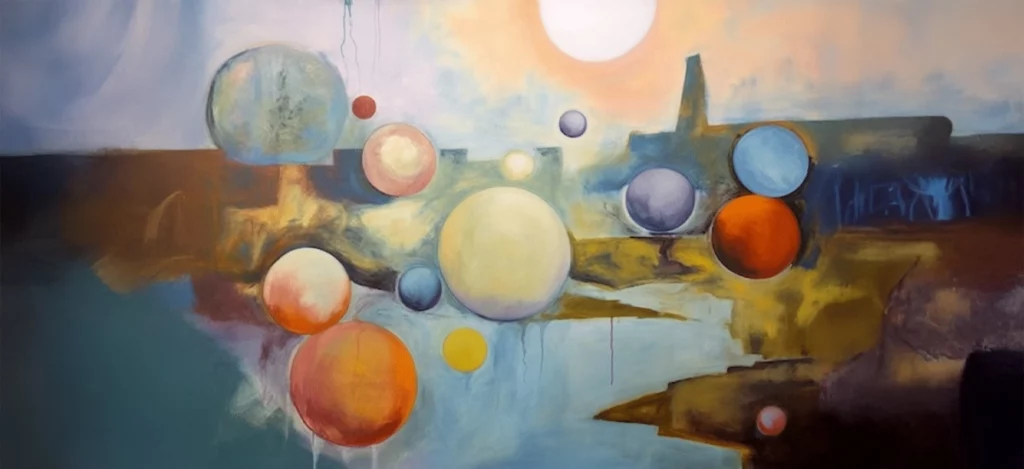

Saltless Dough Balls
“Whosoever offers Me, with devotion, a leaf, a flower, a fruit, or water — that I accept, the pious offering of the pure in heart.” –Bhagavad Gita, 9.26
The world is vast, and we are very small. Your two hands cupped together can hold a little pile of sand, a tiny animal with a fast-beating heart, a few spoonfuls of water that drip through your fingers, and not much more.
Our lives pass only a little slower than the changing of the seasons. The moon shows her full white face and her lithe crescent only so many times between your first gasp of air and the moment when someone looks at your body and sees only a body, and thinks, “Where did she go?”
Days and Nights of Brahma
On the scale of the universe, a human life is not so much. Even on the scale of the Earth — if the entire history of the planet were a single day, the human species would emerge one minute and seventeen seconds before midnight, and all of recorded history would take place in only a few seconds.
Scientists estimate the Earth’s age at 4.5 billion years, with the universe itself exploding into existence some 13.7 billion years ago.
The Hindu scale of creation is even more expansive. Unfathomably long cycles of time repeat with no beginning and no end, punctuated by periods of dissolution when all of manifestation, the dream of Consciousness, is absorbed back into its source.
“One day of Brahma lasts a thousand cycles of the four ages and his night also extends for the same span of time. The wise who know this understand the reality about day and night.
“At the advent of Brahma’s day, all living beings emanate from the unmanifest source. And at the fall of his night, all embodied beings again merge into their unmanifest source.
“Multitudes of beings repeatedly take birth with the advent of Brahma’s day, and are reabsorbed on the arrival of the cosmic night, to manifest again automatically on the advent of the next cosmic day.
“Transcendental to this manifest and unmanifest creation, there is yet another unmanifest eternal dimension. That realm does not cease even when all others do.
“That unmanifest dimension is the supreme goal, and upon reaching it, one never returns to this mortal world. That is My Supreme Abode.” (Bhagavad Gita, 8.17–21)
One day and night of Brahma, the creator of the universe, is equal to 8.64 billion human years, and his entire lifespan extends for one hundred of his years, or 311 trillion human years. After this, he dies, and the universe is absorbed by the inhalation of Vishnu.
Upon Vishnu’s exhalation, life is poured back out into manifestation. Brahma and the universe are reborn — or rather, countless thousands of universes, each with its own presiding Brahma.
The Immense and the Infinitesimal
And yet here we are, on our little round rock floating through the infinity of space and time, living our lives one day at a time. Going to our jobs, starting families, building houses, or packing all our things into boxes to move to another one. Making friends, making love, making pasta. Crying because someone has died or because someone doesn’t like us the way we like them.
I share this contemplation not to trivialize your life but to put its contours in perspective. Searching for the Infinite, vision expands wider than the universe and smaller than an atom, and neither the immense nor the infinitesimal cast any ownership on the Absolute.
The massive scope of the cosmos does not preclude the special providence in the fall of a sparrow. It neither explains nor denies the great care by which the Divine Will guides each of us out into the labyrinth of separate existence, through each twist and turn, and finally back home.
Supernovas and colliding galaxies, the birth of stars, the buzzing of electrons in an atom, and the extinction of the dinosaurs all exist only in relation to God — as does the blink of your eye, your new relationship, or your childhood trauma.
Cradled in the heart, all things exist in equal measure. Only the mind creates distinctions of better or worse, greater or lesser importance, valuable or unimportant.
Planets, Atoms, Balls of Dough
Another contemplation, this one from the Gaudiya Vaishnava tradition.
Sanatana Goswami, one of the leading disciples of Sri Chaitanya Mahaprabhu, lived for a long time as an ascetic in the woods of Vrindavan, alone except for his murti of Krishna. He would beg for some flour to mix with water into a kind of chapati dough, but in the absence of a rolling pin or pan to make the flatbread, he would simply roll the dough into balls and cook them in his campfire.
These balls he would offer to Krishna and then eat as his staple diet — enough to live off of, but so plain that once Krishna Himself appeared to Sanatana and requested if maybe, just maybe, could Sanatana add a little salt next time?
“I’m sorry, my dear,” Sanatana replied to the Supreme Lord, “but as You can see, I’m only a humble beggar! I’m giving You all that I have.”
If we are honest, none of us have much more than saltless dough balls to offer to God.
We are poor beggars in these borrowed bodies, dependent on many other beings and external conditions for our basic survival, not to mention fulfillment.
The difference between material success and failure in human life is essentially nil on even a slightly wider scale. Even the grandest achievement you can imagine will be merely a blip in the historical records after a hundred or a thousand years, if there are still human beings then keeping historical records.
Give it another ten thousand years, another twenty thousand, and what will remain?
In this dimension, everything you do is utterly insignificant.
And yet we still have Sanatana — wise, learned, Self-realized Sanatana Goswami — rolling up his balls of plain flour and offering them to Krishna.
In the dimension of the heart, it doesn’t matter how much you give to the world but how much of yourself you give.
Walking the path of love means your whole heart goes into the fire. Hold onto one scrap, one crumb to feed your own concepts or fears, and the current doesn’t flow through you. Let it go and you are a live wire — the power of the Infinite animates everything you do; let it go and you are alive.
You have very little to give, so why not give it all?
Give yourself, your life, your heart. It doesn’t matter how slim the offering, how little you have to give. Our Beloved wants you, not your things.
Sincerity has no measure or limit. All the vastness of the cosmos does not outweigh the devotion in the heart of an honest lover of God.
The Perfect Span of a Human Life
You have very little time, yet all the time in the world. One human lifetime, nothing more, nothing less. Whether that life lasts for a day or a hundred years, it is precisely the time you need.
Whatever conditions you find yourself in, this is the soil from which you will grow. Your life, not anyone else’s, is the ideal scenario for you to serve, learn, and realize your highest potential — no matter what you feel is lacking, how you think it could be easier or should be different. It is the sandpaper precisely shaped to file down your rough edges.
It is the road underneath your feet already, and your only task is to walk.
Naveen is a Hridaya teacher and a frequent contributor to our blog. You can read all of her posts here.