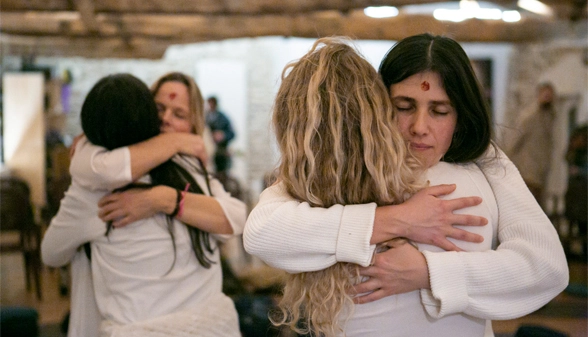
Applications for the Hridaya Teacher Training Course are now open! Spend 3 months diving into the Self. Apply Now!


Love meditation, teach what you love, become what you love.
This simple affirmation is the essence of the Hridaya meditation and yoga teacher training journey. It’s an invitation to open yourself to a lifetime of spiritual exploration and accomplishment. To directly experience the power of meditation. And to integrate this wisdom in daily life, becoming a living embodiment of the teachings.
Over the 12 weeks of the Hridaya Teacher Training Course (HTTC), daily asana practice, meditation, and theoretical teachings will initiate you in the art of meditation, the contemplative approach to Hatha Yoga, and the non-dual vision. This intensive framework will support you in discerning the subtleties of these profound teachings. You’ll experience a blossoming of awareness and gain the skills you need to make these teachings come alive for others. And, the bonds you forge in the community will sustain and inspire you long after the program is over.
Join us for this 500-hour Yoga Alliance-registered meditation and yoga teacher training. Fall in love with meditation. Gain deep insight into the nature of the Self. Recognize love-awareness as your essence. Feel confident sharing the path of meditation as a way of life.
The course is presented in English. Find more information in the tabs below.
HTTC Dates: September 19–December 13, 2026
Location: Longeval, France
Application deadline: April 30
Full payment deadline: August 12
Prerequisites: Participation in two on-site 10-Day Hridaya Silent Meditation Retreats and completion of Hridaya Yoga Retreat: Module 2 is required before enrollment.
It includes:
The HTTC has a maximum enrollment of 33 participants.
To apply, please submit this Application Form. For more information about the application process, please see the Application & Selection tab.
The 2026 HTTC tuition fee is €3,500. For complete information regarding fees, please see the Payment & Refunds tab.
HTTC classes are held six days per week, Monday to Saturday, approximately 8.5 hours per day. During the two silent meditation retreat periods, the schedule is approximately 10 hours per day for 10 days straight.
Hridaya Yoga France is a residential centre. Accommodation and meals are offered at a 25% discount to our usual rates for the duration of the three-month course.
Accommodation options range from 6-bed/4-bed dorms and 3 & 2-bed shared rooms through to private single and double-bed rooms with or without private bathroom.
Vegan meals are served at our center with breakfasts, lunches and dinner all available.
Indicative package pricing (including tuition and all meals) is as follows:
6-bed dorm: €6,560
4-bed dorm: €6,688
3-bed shared: €7,166
2-bed shared: €7,516
Single room: €8,919
Double room: €9,094
Single ensuite: €9,811
Double ensuite: €10,449
If you have any questions, please contact ttc@hridaya-yoga.com.
The Hridaya Teacher Training Course is a profound experience, both a challenge and a celebration of awareness and life. It’s an important step in the journey to reveal your True Nature. You may encounter difficulties, wild rides, painful ego cramps, droughts, self-doubt, impatience, and frustration—but also a fascinating blossoming of your being, openness to new horizons, spiritual insights, deep love, ecstasy, stillness, and peace.
Before enrolling in this journey, please stop, take a deep “breath of awareness,” and ask yourself this question:
“Is the HTTC’s training in yoga and meditation—and its potential outcome—in tune with my ideals in life?”
If the answer is “YES,” then please be aware that the program requires love for meditation and yoga practice, an investment of time and energy, earnestness, an increased capacity to deal with challenges, spiritual aspiration, intuitive openness, a “transrational” understanding of the non-dual teachings, dedication, a deep longing to reveal your essence, surrender, compassion, the willingness to help others, and trust in the Heart, in Life… Of course, you will be supported in this process by the Hridaya practice, teachings, teachers, and sangha. As a deeper surrender of personal limitations arises, a stronger and more flexible character will develop.
Enrolling in this program with full responsibility regarding its requirements and echoes in itself represents an expression of spiritual maturity.
Therefore, we ask you to carefully read all of the HTTC information in the tabs to the left. Then, continue to meditate on this possibility in your life.
As Swami Vivekananda said, “If you are full of your own greatness and irritated by the slightest discomfort, you will never be a true practitioner.”
The first month of the HTTC serves as a trial period during which you will be evaluated. Emphasis will be given to your level of enthusiasm, dedication, and aspiration. At the end of this period, a decision will be made as to whether or not you have demonstrated the necessary qualities to become a Hridaya teacher.
Full-hearted participation in the HTTC—with intelligence, humbleness, and trust—will slowly shape you into a proper vessel for the profound teachings of Self-awareness, quenching your thirst for the Truth and supporting others in doing so.
From the Hridaya perspective, teaching is not just sharing knowledge, but sharing yourself. It is an aspiration that arises naturally when you see the benefits of the teachings and witness your own deep transformation.
Teaching Self-awareness is a lifelong commitment to being a student—a student of Stillness, of Love, of the Heart. It implies the constant practice of embodying the teachings, cultivating integrity, humbleness, deep surrender, patience, perseverance, love, gratitude, generosity, pure intention, and enthusiasm—the qualities of an Open Heart.
Being a Hridaya teacher requires intense formal and informal training, which will definitely not end when the HTTC finishes. The senior Hridaya teachers will continue to support you, offering advice and specific feedback to further develop your readiness, skills, talents, and trust in Oneness. The spiritual friendship between all of us becomes in itself a beautiful expression of non-duality.
We aspire to offer you much more than a formal training at the end of which you receive a yoga teaching certificate. There is an increasing request for Hridaya teachers in many spiritual centers around the world. We would appreciate it if your pure intention is to continue practicing yoga, meditation, and Self-Inquiry, and preparing yourself to become an active Hridaya teacher. You will continue to have our support, which is another reason we consider this step the beginning of a beautiful lifelong journey.

The HTTC is not just a 3-month program designed for you to acquire specific knowledge, improve yourself, and get a certificate. It opens you to a lifelong journey. Practically speaking, the communion in ideals, principles, and actions, the friendship, the teachings, and the support continue even after the course is over.
The Hridaya Community welcomes all of our teachers and will actively support you in transmitting the Hridaya ideals, perspectives, and techniques.
The HTTC transcends the formal style of a course in which you would be labeled a “student” and be in a purely receptive position for three months in order to become a new person, labeled “teacher.” Instead, we’ll continuously learn together, as students and teachers, to go beyond roles.
In this course, the instructional experience starts from a different paradigm. We respect each other beyond roles, appreciating the gifts each person brings, supporting the beauty and inherent creative power that lies in every soul. In this way, real love can grow.
The HTTC encourages spontaneity, which imbues the course and our relationships with freedom, freshness, and dynamism.
Emphasizing creativity is a way to learn in freedom and love and to cultivate our best, most harmonious qualities. This includes the need to be systematic and understand order. When a spiritual school is based on quality and sattvic standards, it naturally blossoms in aspiration, beauty, art, harmony, and respect for Love.
If a spiritual organization only focuses on quantity and a franchise-like style that ignores specificities, it can risk rapid degeneration. When you put enthusiasm into it, work is approached not through quantity but quality. Therefore, awareness, intelligence, love, and creativity are present.
Confidence and faith in the infinite ocean of Light that resides in your Heart must radiate from the depths of your being before you can transmit this trust to your students. This is the best way to teach, a Heart (Self)-affirming attitude free from the stories of the ego. It’s about learning how to surrender (which doesn’t mean not being adequately prepared). It’s about cultivating awareness in what you actively do while teaching and throughout your life.
Real transformation is only possible when the teaching becomes an offering to the Spiritual Heart. Without an intuition of the Ultimate, it isn’t possible to offer teachings that inspire wisdom, love, and happiness. Thus, loving and offering your gifts to the world should go beyond personal limitations, as in the Renaissance, for example.
Even though this course includes formal examinations based on solid theoretical preparation, we’ll place more emphasis on keeping the spirit of Hridaya—naturalness, love, awareness. Cultivating the Heart, which is essential for everyone, can’t be taught in a strictly formal, mechanical way. We are not encouraging a “competitive spirit.” You need only to show and expand your possibilities and gifts, not necessarily in comparison or opposition to others. By living in awareness, Self-Inquiry, freedom, and beauty, you become the best teacher. Then you no longer feel the need to prove anything to others in a competitive or pushy way.
When you are centered mainly in the mind, in thinking, there is always a feeling of lack and a pressure to do something. In the awareness of the Heart, there is a sense of fulfillment. When you knowingly live in the Heart, there is no feeling of lack, frustration, or agitation.
Only by passing beyond the typical way of teaching and receiving can you transcend the mind. Of course, the mind, the intelligence, is needed. At the same time, the HTTC invites you to express and cultivate inspiration, imagination, heart, beauty, presence, and stillness, as these are qualities you will seek to awaken in your future students.
Therefore, the HTTC doesn’t have a dry, theoretical approach. It’s a living course (through its vision, methods, and attitudes) that aims to make these teachings resonate more deeply within every student. The teachings are rooted in the Consciousness of Oneness, and our highest priority is maintaining the universality of the message. Even though Hridaya Yoga has its specificities, it is essential to avoid dogmas.
The real competence of a Hridaya teacher is not based on competition and self-image but on love and intimate inner knowledge. Because of this, people naturally are drawn to our teachings. Both teachers and students understand that the radiance of the Heart is the only authority. Temporal authority, which the role of “teacher” provides, flows from this knowledge, this love. And love has its own ultimate authority.
We strongly believe that a meaningful education should arise out of love. Then, people will learn the non-dual approach to meditation and Hatha Yoga—because they love it. In this way, you can share what you love and what you have learned.
Each of us is learning how to create the best conditions for the revelation of our True Nature, which can’t be based on rigid rules. The harmony that radiates from the Self is the ultimate sovereign authority. The HTTC encourages an education and culture free from dogmas, personal interpretations, drama, and wishful thinking. Instead, we focus on seeing things as they are, from the stillness of the Witness Consciousness.
Another important preoccupation for this course is related to formalizing the teachings. Although the teachings of advaita, non-duality, are essentially beyond mind, properly transmitting them requires intelligence and inspiration. That’s why the HTTC brings maximum clarity to its main concepts: the Sacred Tremor of the Heart, Hridaya Meditation, the Heart Center, Self-Inquiry, Hridaya Hatha Yoga, samarasa, Open Attention, the Witness Consciousness, etc.
The Hridaya Community and Sahajananda will do what we can to support you in giving meditation and Hatha Yoga classes, workshops, courses, etc. We do this freely and don’t expect any portion of the income you earn from teaching. The non-duality of the Heart is the inheritance of all humankind. Advaita is not just for a few well-educated people, but a universal truth that belongs to all humanity.
Still, we encourage your contribution—that you continue to work with us to improve how the message of the Heart is shared.
The HTTC promotes the non-dual vision. This means that there is only one inseparable domain of the Heart. When you truly understand this principle, you can apply it to teaching and all your activities.
As Chuang Tzu said:
“Great knowledge sees all in one.
Small knowledge breaks down into the many.”
All that is spiritual, uplifting, beautiful, noble, good comes from this global perception.
The HTTC Flows in 3 Main Directions:
Paraphrasing an old Taoist saying, the HTTC doesn’t want to give you a fish, but to teach you how to fish. In any case, as you are embarking on a teacher training in meditation and yoga, you should be already good at fishing. The HTTC serves to inspire you to go into the deepest water.
We wish you an inspiring journey into the Real!
Before applying for the HTTC, please carefully read the information in the tabs, including:
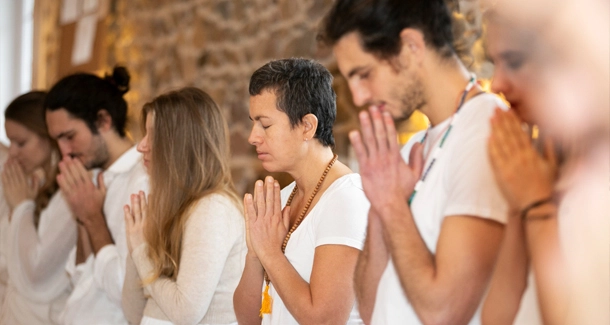
If you have any questions, please contact ttc@hridaya-yoga.com.
The following Criteria for Certification must be met by all students wishing to become Hridaya Meditation and Hatha Yoga teachers.
If during the HTTC, any staff member becomes aware of a breach of these criteria they will notify the HTTC Administration. We will investigate and address the matter promptly, in a case-appropriate manner.
We reserve the right to deny certification to any student who does not fulfill course obligations or who does not meet HTTC standards, as detailed below. Teachers’ and practicum supervisors’ knowledge of a student’s performance, participation, and aspiration will also greatly determine the successful completion of the course.
If certification is withheld, the decision to grant the student permission to retake the course will be at Sahajananda’s sole and final discretion.
Abstinence from recreational drugs, alcohol, and cigarettes is required. Students attempting to quit smoking may have a grace period for the first 30 days of the course.
Full participation is required. This is defined as participation in all facets of each scheduled session: theoretical presentations, asana practices, meditations, interviews, practicums, retreats, etc.
Attendance of at least 90% of all classes is necessary to pass the HTTC. This allows for any unexpected sick days, emergencies, or logistical days (i.e., visa runs). Students are to contact the HTTC Coordinator before missing any class. It is the student’s responsibility to make up any material missed during excused absences. Please note that a late arrival of 20 minutes or more is considered an absence.
Students who don’t meet the attendance minimum will not receive teaching certificates. If the excessive absence is due to a legitimate reason (illness, medical emergency, etc.), they may enroll in a future HTTC for 25% of the tuition fee.
When participating in a future course, the student must attend all classes and pass all exams (with the same margin of absenteeism noted above) to earn the certificate. If the student again fails to meet the HTTC graduation requirements, they may apply to reattend the course, paying full tuition.
In addition to the attendance requirement, students must pass 3 written exams to successfully complete the course. Exams include a combination of multiple-choice and essay questions formulated from lectures and supplemental course materials. The final exam also includes a Hatha Yoga test. Participants must complete the course with a cumulative passing exam average, in addition to attendance verification, in order to receive their teaching certification.
Successful completion of all practicum teaching assignments is required. Presentations will demonstrate the student’s ability to teach Hridaya Meditation and Hatha Yoga. This capacity includes a good command of the scripted mnemonics as well as the theoretical absorption of the teachings, as demonstrated by the proper presentation of course material, correct answers to student questions, etc.
After graduation, Hridaya Meditation and Yoga teachers are expected to adhere to certain standards.
If there is a professional or ethical complaint against a Hridaya teacher, an inquiry will be made. If we find a legitimate basis for the complaint, it could result in the suspension of the teacher or limitations placed on the teacher’s use of the name “Hridaya.”
Upon graduation, we encourage HTTC participants to teach Hridaya Yoga. The name “Hridaya” should be honored by the behavior and competence of the teacher.
The HTTC is registered with Yoga Alliance (YA) as a 500-hour course.
Founded in 1999, YA is the world’s largest international nonprofit organization serving the yoga community. Since its inception, YA has worked to establish clear, consistent standards for yoga teachers worldwide, while honoring diversity, professionalism, and ethics. The organization has high standards for its members, and registered teacher trainings must include a minimum number of hours across key content areas such as yoga practice, philosophy, teaching methodology, and anatomy. The HTTC curriculum not only meets these requirements but surpasses them.
Hridaya has been a Registered Yoga School since 2011. Upon successful completion of the course and after fulfilling a minimum number of teaching hours, HTTC graduates will be qualified to join YA at the Registered Yoga Teacher 500 designation. Note: Hridaya does not register HTTC graduates with YA. New teachers may choose to become members by registering themselves on the YA website.

The 2026 HTTC tuition fee is €3,500
The full payment deadline is August 12. The course fee includes complimentary enrollment in two 10-Day Hridaya Silent Meditation Retreats led by Sahajananda. Participation in these retreats is a mandatory part of the course curriculum.
Hridaya Yoga France is a residential centre. Accommodation and meals are offered at a 25% discount to our usual rates for the duration of the three-month course.
Accommodation options range from 6-bed/4-bed dorms and 3 & 2-bed shared rooms through to private single and double-bed rooms with or without private bathroom.
Vegan meals are served at our center with breakfasts, lunches and dinner all available.
Indicative package pricing (including tuition and all meals) is as follows:
6-bed dorm: €6,560
4-bed dorm: €6,688
3-bed shared: €7,166
2-bed shared: €7,516
Single room: €8,919
Double room: €9,094
Single ensuite: €9,811
Double ensuite: €10,449
Upon approval of your application, you will also receive an email regarding registration. Full payment or an initial deposit of 50% is required to confirm your enrollment. We prefer payment via bank transfer.
Once your payment has been received, you will receive a confirmation via email.
Any remaining balance due is payable by August 12.
Full payment will constitute a confirmation of your place in the course. If we don’t receive the final payment by the stated deadline, we will assume that you have canceled your enrollment.
Hridaya Yoga is not responsible for payment errors, personal problems with credit card accounts, power outages, internet inaccessibility, bank holidays, etc. These guidelines are given well in advance of the deadline to give you the opportunity to verify all of these factors and make a timely payment. Please take advantage of this advance notice to investigate your account maximums, account functionality, etc.
We advise you to handle any payment issues in advance, as we cannot make an exception if you miss the final payment deadline.
In special cases, Sahajananda may choose to offer scholarships to students with a strong aspiration to serve but few economic resources.
You may cancel your enrollment by emailing us. Note that the following refund guidelines will apply.
Cancellation before the full payment deadline:
Cancellation after full payment deadline:
Hridaya holds very high standards for its teachers. There is a selection process that applies to each level of the course. To graduate, you will be expected to pass three exams and earn a positive final teaching evaluation.
If you don’t pass the final exam, you may retake it. If you fail the make-up exam, you may participate in a future HTTC for 50% of the tuition fee.
You can find a detailed explanation of HTTC expectations for students in the Certification Criteria and Terms tabs.
If you have any questions, please contact ttc@hridaya-yoga.com.
When considering whether to enroll in the HTTC, please understand that the course condenses an extensive quantity of advanced yogic material into a 12-week, 500+-hour training.
Don’t underestimate the mental and physical demands you will face. Please seriously evaluate your level of physical, psychological, and spiritual maturity before enrolling in this course.
We have structured the HTTC to help students dedicate themselves to a contemplative life and become mature meditation and Hatha Yoga teachers. Therefore, extensive consideration has been put into the schedule and methodology presented.
Please read the following statements. By checking the Terms of Agreement box on the application form, you are affirming that you have read, understood, and agreed to accept the established standards.
I commit to doing my best to participate according to the course structure. If I have specific personal needs, yogic or otherwise, I will discuss them with an HTTC administrator.
By virtue of being an intensive program, the HTTC may raise personal issues or shortcomings. The program encourages personal growth and, therefore, may impel considerable changes in attitude. For these reasons, the HTTC can be challenging and demanding. I accept responsibility for all aspects of my behavior during this program.
Adherence to punctuality is one of the primary factors in the success of the HTTC. I accept responsibility for being on time for all program sessions.
There will be many opportunities for practice, study, and other activities at the school. I accept responsibility for managing my time, diet, and personal relationships in ways that support my full participation in and attendance at the HTTC.
According to the Hridaya system, it is necessary to maintain a level of cleanliness and purity in combination with meditation and Hatha Yoga practice to ensure the safety and effectiveness of spiritual practices.
I agree to accept that, for the duration of the HTTC, all use of tobacco and other illicit substances is expressly forbidden and can prove grounds for immediate expulsion from the course. Moreover, I understand that Sahajananda reserves the right to suspend a teacher at any time if we learn about non-compliance with this essential rule.
Hridaya Yoga students come from a variety of countries and backgrounds. In order to create a supportive environment, I assume responsibility for maintaining an attitude of respect toward my teachers and fellow students. If any interpersonal difficulties or conflicts arise, I pledge to seek advice from HTTC teachers and administrators.
Hridaya Yoga offers spiritual teachings outside the parameters of any one specific religion. The HTTC raises issues that are metaphysical in nature, concepts, and theories that may challenge my belief system. I agree to keep an open mind and to exercise common sense, discernment, and a balanced attitude in order to fully appreciate the teachings offered.
Application Deadline:
Course Dates:
If the dates listed above don’t align with your schedule, you may still apply, as spaces may become available at other times.
Please see the Program Overview tab above.
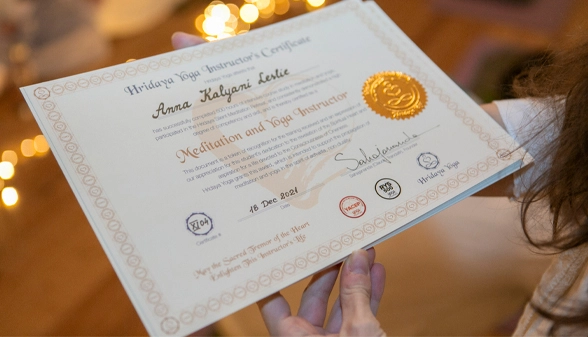
After the successful completion of the HTTC, attendees will receive a Hridaya Yoga Teacher’s Certificate. This certificate confirms that you have completed over 600 hours of meditation and Hatha Yoga teacher training (the HTTC is registered with Yoga Alliance, following standards for their 500-hour level teacher training programs). This is the first step to teaching Hridaya Yoga.
With this certificate, HTTC graduates can start the process of developing their skills as teachers in yoga studios all over the world, as well as with private students.
Yes. The HTTC is both a practical and theoretical training designed to make you a confident and effective Hridaya teacher.
The HTTC provides a supportive environment in which students get all the necessary skills for developing themselves both as meditation and Hatha Yoga instructors. Newly certified Hridaya teachers will feel confident in teaching workshops, silent retreats, and Hridaya Hatha Yoga classes.
The HTTC includes daily Hridaya Meditation and asana practice. In order to see how this form of meditation resonates and transforms you, the completion of two on-site 10-Day Hridaya Silent Meditation Retreats is a prerequisite.
Ease in practicing asanas comes with time. Because of this, a foundation in basic and fundamental yoga postures is recommended for this training. You’ll learn these postures in the Hridaya Yoga Retreat: Module 2, another prerequisite for the HTTC.
We offer to all those who want to live with an Open Heart and to share this message, the opportunity to discover the beauty of yoga and meditation.
We don’t put an emphasis on performing the physical postures perfectly but on the spiritual maturity of the students who are willing to learn gradually and to become conscious of the limits of their own bodies. In meditation, practitioners realize that they are not just the physical body. Thus, in Hridaya Yoga, we learn not to become free from the body, but to become free in the body.
Developing awareness and love is our main purpose during the HTTC. This applies to the physical body, too. Thus, asana practice becomes joyful and relaxing. During the training, you will deepen your understanding of the asanas while simultaneously learning how to teach.
Therefore, the yoga “skills” required for enrolling in the HTTC would be: love, patience, spiritual aspiration, maturity, perseverance, and diligence.
Students who want to enroll in the HTTC must not consume drugs, alcohol, or cigarettes. While the occasional glass of wine need not generate concern, frequent users of alcohol must stop this unhealthy practice. Likewise, smokers and drug users must completely quit if they aspire to enroll in the HTTC.
To become a Hridaya Yoga teacher implies that you step on the path of awareness and responsibility for the benefit of yourself and others. Thus, all those who aspire to do the HTTC have to understand that there is no room for harmful habits if they want to give guidance to others on the spiritual path.
People with psychological disorders are advised to take their time and heal themselves first, and then they apply for an HTTC. For this, we strongly recommend Hridaya Silent Meditation Retreats and Hridaya Hatha Yoga Modules.
Generally speaking, those who wish to enroll in the HTTC should consider the responsibility they take on by becoming Hridaya Yoga teachers.
Those who enroll in the HTTC need to aspire from the bottom of their hearts to live a yogic life based on common sense, meditation, noble attitudes and ideals, and compassion.
Before enrolling in the HTTC, you must participate in at least two on-site 10-Day Hridaya Silent Meditation Retreats and graduate from Hridaya Yoga Retreat: Module 2.
You may apply to the HTTC before completing these programs, but will not be able to join the course until you have done them. This is absolutely necessary, as they allow you to gradually build up the skills and knowledge required of a Hridaya Yoga teacher.
The HTTC is a very intensive course that comprises more than 600 hours of training in only three months. Attendees should expect 8–9 hours of training per day, six days per week (this includes meditations). There is one day off per week.
The course includes two 10-Day Hridaya Silent Meditation Retreats and a 2-day Dark Room Retreat. When effort appears in this intensive program, instead of focusing on it, we focus on the Spiritual Heart, and effort dissipates. Hridaya methodology emphasizes relaxation, joy, and Love-Awareness.
The HTTC doesn’t include an extreme Hatha Yoga practice. Hatha Yoga practice is not designed to train students in the perfect performance of asanas, but to develop an awareness of the physical and energetic bodies and the capacity to transform the Hatha Yoga practice into meditation.
Therefore, even though students are taught how to perform asanas correctly and how to teach others to perform them, the emphasis of the Hatha Yoga practice is not on physical performance but on achieving a holistic knowledge of Hatha Yoga and gaining the skills necessary to teach Hatha Yoga to others with awareness and profound understanding.
There are usually 2–3.5 hours of Hridaya Hatha Yoga daily during the HTTC.
The HTTC includes approximately 30 hours of anatomy and physiology classes. Anatomy classes are interactive in order to facilitate the acquisition of this special knowledge in an easy and friendly way. The study of anatomy is closely linked to the practice of Hatha Yoga.
Apart from this, there are teachings about subtle anatomy (nadis, chakras, kundalini) and the traditional subtle bodies.
The HTTC is designed as a three-month intensive meditation and yoga retreat comprising teachings, Hatha Yoga practice, and meditation. Therefore, it is also suited for those who may not wish to be teachers at this stage but would like to deepen their own meditation practice and experience of yoga.
However, they will follow the same training as everyone, including the teaching methodology classes, practicum sessions, and exams.
In our experience, graduates of the HTTC have shown a desire to teach Hridaya Meditation and Hatha Yoga, even if they were one of those who initially enrolled in the HTTC for an individual retreat.
The HTTC can have a maximum of 33 students.
Students from all religions or followers of different spiritual paths are welcome to join the HTTC, which represents a profound way to discover the essence of all spiritual traditions—our True Nature, Hridaya, the Supreme Self.
Hridaya Meditation, a profound understanding of who you are, can only deepen your own spiritual practice. Since Hridaya Meditation is a tool for revealing our Real Nature, it has a universal character.
After you submit the HTTC application, you will be sent a confirmation that we have received all the needed information. The selection process will begin after the application deadline and will end one month later. The process may include an interview with Sahajananda or another senior Hridaya teacher.
Upon acceptance into the course, you will need to register via our booking system—a link will be included in the confirmation email.
If you aren’t selected for admission after the initial review, you’ll be placed on the waiting list. As people accepted to the course sometimes withdraw, you may still have a chance to enroll.
You must pay the tuition fee by August 12th. If you haven’t paid in full by this deadline, your enrollment will be canceled and the next person on the waiting list will be given your spot.
If you want to withdraw from the HTTC, please email ttc@hridaya-yoga.com. For more details, see the Payment & Refunds tab above.
Yes. When the course is full we accept applications for the waiting list. Students who are accepted to the waiting list and have not yet been accepted to the HTTC may withdraw from the waiting list at any point.
Yes. HTTC participants receive an orientation booklet at the beginning of the program, monthly course booklets totaling more than 900 pages, an anatomy and physiology booklet, and an HTTC Kit containing an additional booklet with advice and recommendations for Hridaya Yoga teachers, inspiring books by Ramana Maharshi, audio files of HTTC lectures, PowerPoint presentations used during the lectures, and other useful materials.
Each student also receives a Hridaya Yoga teacher T-shirt to wear during practice teaching sessions.
The HTTC is held at our centers in Longeval, France and Mazunte, Mexico. Please refer to the Program Overview tab above to see where this year’s course will take place.
The HTTC tuition fee does not include accommodation and meals.
Upon acceptance to the HTTC, you’ll be sent more information about accommodation options.
Our centers offer wholesome vegan meals. Upon acceptance to the HTTC, you’ll be sent more information about meal plan options.
From our experience, meals are very good times for socializing and bonding with others, as sharing experiences is an important aspect of the Hridaya Community.
Please refer to the Payment & Refunds tab above.
Sahajananda recommends that you read all the books in the following list prior to the training in order to familiarize yourself with the non-dual teachings:
Maharshi, Ramana, Who Am I? (Nan Yar?)
Maharshi, Ramana, Self-Inquiry (Vichara Sangraham)
Maharshi, Ramana, Forty Verses on Reality
Maharaj, Nisargadatta, I Am That
Satyananda, Swami, Four Chapters on Freedom: Commentary on the Yoga Sutras of Patanjali
A comprehensive list of suggested readings, including Sahajananda’s commentaries, can be found at Suggested Reading.
From that list, we have selected some of the most relevant books for Hridaya Yoga teachers:
1. Classical Texts of Advaita Vedanta
Ashtavakra Gita
Dattatreya – Avadhuta Gita (The Song of the Ever-Free)
Shankara, Adi – The Crest-Jewel of Discrimination (Viveka-Chudamani)
2. Works of Ramana Maharshi and His Disciples about Advaita Vedanta, the Self-Inquiry Method, and His Perspective on Reality
Ebert, Gabriele – Ramana Maharshi
Godman, David – Be As You Are: The Teachings of Sri Ramana Maharshi
Maharshi, Ramana – Who Am I? (Nan Yar?)
Maharshi, Ramana – Self-Inquiry (Vichara Sangraham)
Maharshi, Ramana – Forty Verses on Reality
3. Works by Nisargadatta Maharaj and His Disciples
Maharaj, Nisargadatta – I Am That
Maharaj, Nisargadatta – Consciousness and the Absolute
4. Works of Other Contemporary Sages and Spiritual Teachers
Klein, Jean – Who Am I?
Sivananda, Swami – Vedanta for Beginners
Tolle, Eckhart – The Power of Now
Tolle, Eckhart – Stillness Speaks
Tolle, Eckhart – A New Earth
5. Meditation
Sivananda, Swami – Mind, Its Mysteries and Control
6. Raja Yoga
Satyananda, Swami – Four Chapters on Freedom: Commentary on the Yoga Sutras of Patanjali
7. Miscellaneous
Feuerstein, Georg – Encyclopedic Dictionary of Yoga
Feuerstein, Georg – Shambhala Guide to Yoga
Sivananda, Swami – Bliss Divine
Yogananda, Paramahansa – Autobiography of a Yogi
When the HTTC is held in France:
Throughout the course, the weather will vary, from sunny days to overcast days with rainfall and perhaps even snow. In the first few weeks, daytime temperatures are likely to be over 20ºC (68ºF), but will gradually decline with the onset of fall. Come December, daytime temperatures will generally be in the 5-10ºC (40-50ºF) range, with overnight frosts becoming more frequent.
We suggest that you bring comfortable yoga clothing, light and warm clothes, an alarm clock, a flashlight, a journal, a water bottle, a camera, rain protection, a first aid kit, etc.
When the HTTC is held in Mexico:
The weather is ideal during the HTTC season, with tropical sunlight almost daily. The average high during these months is 28ºC (82ºF). Nighttime temperatures may get as low as 18ºC (65ºF).
We suggest you bring comfortable yoga clothing, light and warm clothes for nighttime, a bathing suit, a beach towel, sunglasses, sunscreen, insect repellent, an alarm clock, a flashlight, a journal, a water bottle, rain protection, a first aid kit, etc. Please see our Hridaya Mexico page for more information.
We highly recommend that you have health insurance valid for the entire HTTC period.
HTTC students need to follow the simple rules corresponding to a yogic environment, which are conducive to study, learning, and meditation. As we have mentioned, students are expected to be tobacco, drug, and alcohol-free.
Students are asked to socialize quietly during their breaks when other yoga classes are running in proximity. We recommend students have a healthy diet, such as lacto-ovo-vegetarian, to create proper conditions for yoga practice.
Please see the Certification Criteria tab above.
There will be three exams, one given at the end of every month. They are all written tests with a combination of multiple-choice and essay questions derived from lectures and supplemental course materials. Please see the Certification Criteria tab above for more information.
We recommend that you use your daily free time for exam preparation. One hour per day is enough to review the teachings of the day and to note what is unclear. In this way, you’ll keep up with the pace of the teachings and you’ll absorb the knowledge in a continuous flow.
During the HTTC we spend around 2-3 hours in meditation daily. Apart from this, we recommend that you have a minimum daily individual meditation practice of at least 30 minutes at the end of the day.
The course is six days per week, from Monday to Saturday. Usually, the days off are Sundays, with the exception of during the two retreats, when the day after the retreat is a day off.
During non-retreat times, the daily schedule generally includes a morning session from 7:00 am–1:00 pm and an afternoon/evening session from 4:00–7:00 pm.
You will have the opportunity to teach under the supervision of an experienced Hridaya teacher three times. The three practicum assignments are designed to help students become confident as Hridaya Yoga teachers.
First of all, Hridaya Yoga teacher are devoted students of Stillness. They don’t aim mainly to transform the life of others for the better but strives to transform themselves into more refined instruments on which the greatest musician, the Self, plays its music of Silence. One day the player, the instrument, and the music will disappear into Oneness.
This is the best gift that we can give to humanity. Despite metaphorical expressions, this represents the concrete sadhana of a Hridaya Yoga teacher—transforming the body, mind, and heart into proper instruments for Self-revelation.
Concretely, Hridaya Yoga teachers assume responsibility for their practice by performing daily meditations, attending meditation retreats every year, and by cultivating the proper attitudes for a Hridaya life.
The HTTC covers the necessary skills and knowledge for conducting Hatha Yoga classes, meditation classes, and Hridaya Retreats of 3, 4, or 5 days.
On completion of the training and after meeting the required teaching hours, new Hridaya teachers may register with Yoga Alliance, paying a membership fee. Yoga Alliance registration offers the added benefit of a listing on their website and the recognition of a national certifying body.
We consider that continuing education is extremely important and valuable, because it will bring more depth to your practice and to how you share the teachings. The requirement for a Yoga Alliance-registered teacher is 30 continuing education credit hours per year. Find out more on their website.
Hridaya offers ongoing workshops and courses that are recommended for Hridaya teachers. For meditation teachers, Sahajananda strongly recommends participation in the 49-Day Pratyabhijna Retreat, an individual meditation retreat with his personal guidance.
All Hridaya teachers are welcome to contact us with questions and to request support. Courses and materials that are developed for Hridaya teachers will be available to all HTTC graduates.
We also send periodic newsletters to inform teachers about activities at our centers, including courses, retreats, and workshops.
Please see the Program Overview tab above.
After the successful completion of the HTTC, attendees will receive a Hridaya Yoga Teacher’s Certificate. This certificate confirms that you have completed over 600 hours of meditation and Hatha Yoga teacher training (the HTTC is registered with Yoga Alliance, following standards for their 500-hour level teacher training programs). This is the first step to teaching Hridaya Yoga.
With this certificate, HTTC graduates can start the process of developing their skills as teachers in yoga studios all over the world, as well as with private students.
Yes. The HTTC is both a practical and theoretical training designed to make you a confident and effective Hridaya teacher.
The HTTC provides a supportive environment in which students get all the necessary skills for developing themselves both as meditation and Hatha Yoga instructors. Newly certified Hridaya teachers will feel confident in teaching workshops, silent retreats, and Hridaya Hatha Yoga classes.
The HTTC includes daily Hridaya Meditation and asana practice. In order to see how this form of meditation resonates and transforms you, the completion of two on-site 10-Day Hridaya Silent Meditation Retreats is a prerequisite.
Ease in practicing asanas comes with time. Because of this, a foundation in basic and fundamental yoga postures is recommended for this training. You’ll learn these postures in the Hridaya Yoga Retreat: Module 2, another prerequisite for the HTTC.
We offer to all those who want to live with an Open Heart and to share this message, the opportunity to discover the beauty of yoga and meditation.
We don’t put an emphasis on performing the physical postures perfectly but on the spiritual maturity of the students who are willing to learn gradually and to become conscious of the limits of their own bodies. In meditation, practitioners realize that they are not just the physical body. Thus, in Hridaya Yoga, we learn not to become free from the body, but to become free in the body.
Developing awareness and love is our main purpose during the HTTC. This applies to the physical body, too. Thus, asana practice becomes joyful and relaxing. During the training, you will deepen your understanding of the asanas while simultaneously learning how to teach.
Therefore, the yoga “skills” required for enrolling in the HTTC would be: love, patience, spiritual aspiration, maturity, perseverance, and diligence.
Students who want to enroll in the HTTC must not consume drugs, alcohol, or cigarettes. While the occasional glass of wine need not generate concern, frequent users of alcohol must stop this unhealthy practice. Likewise, smokers and drug users must completely quit if they aspire to enroll in the HTTC.
To become a Hridaya Yoga teacher implies that you step on the path of awareness and responsibility for the benefit of yourself and others. Thus, all those who aspire to do the HTTC have to understand that there is no room for harmful habits if they want to give guidance to others on the spiritual path.
People with psychological disorders are advised to take their time and heal themselves first, and then they apply for an HTTC. For this, we strongly recommend Hridaya Silent Meditation Retreats and Hridaya Hatha Yoga Modules.
Generally speaking, those who wish to enroll in the HTTC should consider the responsibility they take on by becoming Hridaya Yoga teachers.
Those who enroll in the HTTC need to aspire from the bottom of their hearts to live a yogic life based on common sense, meditation, noble attitudes and ideals, and compassion.
Before enrolling in the HTTC, you must participate in at least two on-site 10-Day Hridaya Silent Meditation Retreats and graduate from Hridaya Yoga Retreat: Module 2.
You may apply to the HTTC before completing these programs, but will not be able to join the course until you have done them. This is absolutely necessary, as they allow you to gradually build up the skills and knowledge required of a Hridaya Yoga teacher.
The HTTC is a very intensive course that comprises more than 600 hours of training in only three months. Attendees should expect 8–9 hours of training per day, six days per week (this includes meditations). There is one day off per week.
The course includes two 10-Day Hridaya Silent Meditation Retreats and a 2-day Dark Room Retreat. When effort appears in this intensive program, instead of focusing on it, we focus on the Spiritual Heart, and effort dissipates. Hridaya methodology emphasizes relaxation, joy, and Love-Awareness.
The HTTC doesn’t include an extreme Hatha Yoga practice. Hatha Yoga practice is not designed to train students in the perfect performance of asanas, but to develop an awareness of the physical and energetic bodies and the capacity to transform the Hatha Yoga practice into meditation.
Therefore, even though students are taught how to perform asanas correctly and how to teach others to perform them, the emphasis of the Hatha Yoga practice is not on physical performance but on achieving a holistic knowledge of Hatha Yoga and gaining the skills necessary to teach Hatha Yoga to others with awareness and profound understanding.
There are usually 2–3.5 hours of Hridaya Hatha Yoga daily during the HTTC.
The HTTC includes approximately 30 hours of anatomy and physiology classes. Anatomy classes are interactive in order to facilitate the acquisition of this special knowledge in an easy and friendly way. The study of anatomy is closely linked to the practice of Hatha Yoga.
Apart from this, there are teachings about subtle anatomy (nadis, chakras, kundalini) and the traditional subtle bodies.
The HTTC is designed as a three-month intensive meditation and yoga retreat comprising teachings, Hatha Yoga practice, and meditation. Therefore, it is also suited for those who may not wish to be teachers at this stage but would like to deepen their own meditation practice and experience of yoga.
However, they will follow the same training as everyone, including the teaching methodology classes, practicum sessions, and exams.
In our experience, graduates of the HTTC have shown a desire to teach Hridaya Meditation and Hatha Yoga, even if they were one of those who initially enrolled in the HTTC for an individual retreat.
The HTTC can have a maximum of 30 students.
Students from all religions or followers of different spiritual paths are welcome to join the HTTC, which represents a profound way to discover the essence of all spiritual traditions—our True Nature, Hridaya, the Supreme Self.
Hridaya Meditation, a profound understanding of who you are, can only deepen your own spiritual practice. Since Hridaya Meditation is a tool for revealing our Real Nature, it has a universal character.
After you submit the HTTC application, you will be sent a confirmation that we have received all the needed information. The selection process will begin after the application deadline and will end one month later. The process may include an interview with Sahajananda or another senior Hridaya teacher.
Upon acceptance into the course, you will need to register via our booking system—a link will be included in the confirmation email.
If you aren’t selected for admission after the initial review, you’ll be placed on the waiting list. As people accepted to the course sometimes withdraw, you may still have a chance to enroll.
You must pay the tuition fee by August 12th. If you haven’t paid in full by this deadline, your enrollment will be canceled and the next person on the waiting list will be given your spot.
If you want to withdraw from the HTTC, please email ttc@hridaya-yoga.com. For more details, see the Payment & Refunds tab above.
Yes. When the course is full we accept applications for the waiting list. Students who are accepted to the waiting list and have not yet been accepted to the HTTC may withdraw from the waiting list at any point.
Yes. HTTC participants receive an orientation booklet at the beginning of the program, monthly course booklets totaling more than 900 pages, an anatomy and physiology booklet, and an HTTC Kit containing an additional booklet with advice and recommendations for Hridaya Yoga teachers, inspiring books by Ramana Maharshi, audio files of HTTC lectures, PowerPoint presentations used during the lectures, and other useful materials.
Each student also receives a Hridaya Yoga teacher T-shirt to wear during practice teaching sessions.
The HTTC is held at our centers in Longeval, France and Mazunte, Mexico. Please refer to the Program Overview tab above to see where this year’s course will take place.
The HTTC tuition fee does not include accommodation and meals.
Upon acceptance to the HTTC, you’ll be sent more information about accommodation options.
Our centers offer wholesome vegan meals. Upon acceptance to the HTTC, you’ll be sent more information about meal plan options.
From our experience, meals are very good times for socializing and bonding with others, as sharing experiences is an important aspect of the Hridaya Community.
Please refer to the Payment & Refunds tab above.
Sahajananda recommends that you read all the books in the following list prior to the training in order to familiarize yourself with the non-dual teachings:
Maharshi, Ramana, Who Am I? (Nan Yar?)
Maharshi, Ramana, Self-Inquiry (Vichara Sangraham)
Maharshi, Ramana, Forty Verses on Reality
Maharaj, Nisargadatta, I Am That
Satyananda, Swami, Four Chapters on Freedom: Commentary on the Yoga Sutras of Patanjali
A comprehensive list of suggested readings, including Sahajananda’s commentaries, can be found at Suggested Reading.
From that list, we have selected some of the most relevant books for Hridaya Yoga teachers:
1. Classical Texts of Advaita Vedanta
Ashtavakra Gita
Dattatreya – Avadhuta Gita (The Song of the Ever-Free)
Shankara, Adi – The Crest-Jewel of Discrimination (Viveka-Chudamani)
2. Works of Ramana Maharshi and His Disciples about Advaita Vedanta, the Self-Inquiry Method, and His Perspective on Reality
Ebert, Gabriele – Ramana Maharshi
Godman, David – Be As You Are: The Teachings of Sri Ramana Maharshi
Maharshi, Ramana – Who Am I? (Nan Yar?)
Maharshi, Ramana – Self-Inquiry (Vichara Sangraham)
Maharshi, Ramana – Forty Verses on Reality
3. Works by Nisargadatta Maharaj and His Disciples
Maharaj, Nisargadatta – I Am That
Maharaj, Nisargadatta – Consciousness and the Absolute
4. Works of Other Contemporary Sages and Spiritual Teachers
Klein, Jean – Who Am I?
Sivananda, Swami – Vedanta for Beginners
Tolle, Eckhart – The Power of Now
Tolle, Eckhart – Stillness Speaks
Tolle, Eckhart – A New Earth
5. Meditation
Sivananda, Swami – Mind, Its Mysteries and Control
6. Raja Yoga
Satyananda, Swami – Four Chapters on Freedom: Commentary on the Yoga Sutras of Patanjali
7. Miscellaneous
Feuerstein, Georg – Encyclopedic Dictionary of Yoga
Feuerstein, Georg – Shambhala Guide to Yoga
Sivananda, Swami – Bliss Divine
Yogananda, Paramahansa – Autobiography of a Yogi
When the HTTC is held in France:
Throughout the course, the weather will vary, from sunny days to overcast days with rainfall and perhaps even snow. In the first few weeks, daytime temperatures are likely to be over 20ºC (68ºF), but will gradually decline with the onset of fall. Come December, daytime temperatures will generally be in the 5-10ºC (40-50ºF) range, with overnight frosts becoming more frequent.
We suggest that you bring comfortable yoga clothing, light and warm clothes, an alarm clock, a flashlight, a journal, a water bottle, a camera, rain protection, a first aid kit, etc.
When the HTTC is held in Mexico:
The weather is ideal during the HTTC season, with tropical sunlight almost daily. The average high during these months is 28ºC (82ºF). Nighttime temperatures may get as low as 18ºC (65ºF).
We suggest you bring comfortable yoga clothing, light and warm clothes for nighttime, a bathing suit, a beach towel, sunglasses, sunscreen, insect repellent, an alarm clock, a flashlight, a journal, a water bottle, rain protection, a first aid kit, etc. Please see our Hridaya Mexico page for more information.
We highly recommend that you have health insurance valid for the entire HTTC period.
HTTC students need to follow the simple rules corresponding to a yogic environment, which are conducive to study, learning, and meditation. As we have mentioned, students are expected to be tobacco, drug, and alcohol-free.
Students are asked to socialize quietly during their breaks when other yoga classes are running in proximity. We recommend students have a healthy diet, such as lacto-ovo-vegetarian, to create proper conditions for yoga practice.
Please see the Certification Criteria tab above.
There will be three exams, one given at the end of every month. They are all written tests with a combination of multiple-choice and essay questions derived from lectures and supplemental course materials. Please see the Certification Criteria tab above for more information.
We recommend that you use your daily free time for exam preparation. One hour per day is enough to review the teachings of the day and to note what is unclear. In this way, you’ll keep up with the pace of the teachings and you’ll absorb the knowledge in a continuous flow.
During the HTTC we spend around 2-3 hours in meditation daily. Apart from this, we recommend that you have a minimum daily individual meditation practice of at least 30 minutes at the end of the day.
The course is six days per week, from Monday to Saturday. Usually, the days off are Sundays, with the exception of during the two retreats, when the day after the retreat is a day off.
During non-retreat times, the daily schedule generally includes a morning session from 7:00 am–1:00 pm and an afternoon/evening session from 4:00–7:00 pm.
You will have the opportunity to teach under the supervision of an experienced Hridaya teacher three times. The three practicum assignments are designed to help students become confident as Hridaya Yoga teachers.
First of all, Hridaya Yoga teacher are devoted students of Stillness. They don’t aim mainly to transform the life of others for the better but strives to transform themselves into more refined instruments on which the greatest musician, the Self, plays its music of Silence. One day the player, the instrument, and the music will disappear into Oneness.
This is the best gift that we can give to humanity. Despite metaphorical expressions, this represents the concrete sadhana of a Hridaya Yoga teacher—transforming the body, mind, and heart into proper instruments for Self-revelation.
Concretely, Hridaya Yoga teachers assume responsibility for their practice by performing daily meditations, attending meditation retreats every year, and by cultivating the proper attitudes for a Hridaya life.
The HTTC covers the necessary skills and knowledge for conducting Hatha Yoga classes, meditation classes, and Hridaya Retreats of 3, 4, or 5 days.
On completion of the training and after meeting the required teaching hours, new Hridaya teachers may register with Yoga Alliance, paying a membership fee. Yoga Alliance registration offers the added benefit of a listing on their website and the recognition of a national certifying body.
We consider that continuing education is extremely important and valuable, because it will bring more depth to your practice and to how you share the teachings. The requirement for a Yoga Alliance-registered teacher is 30 continuing education credit hours per year. Find out more on their website.
Hridaya offers ongoing workshops and courses that are recommended for Hridaya teachers. For meditation teachers, Sahajananda strongly recommends participation in the 49-Day Pratyabhijna Retreat, an individual meditation retreat with his personal guidance.
All Hridaya teachers are welcome to contact us with questions and to request support. Courses and materials that are developed for Hridaya teachers will be available to all HTTC graduates.
We also send periodic newsletters to inform teachers about activities at our centers, including courses, retreats, and workshops.
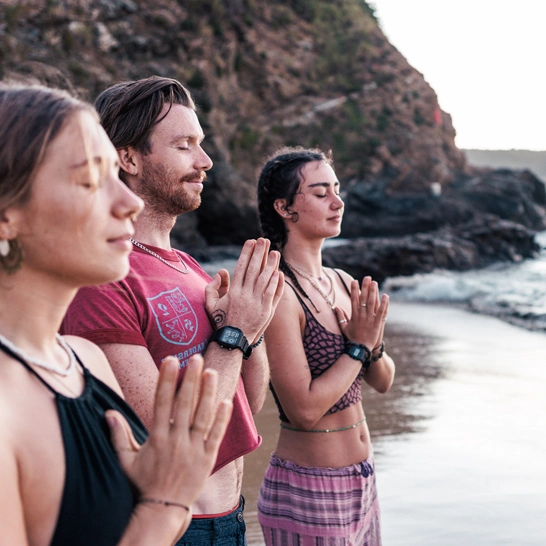
Whatever you call it, it’s that which calls you to look within.
Sign up for the Hridaya Newsletter to enliven your routine with exclusive, inspiring content that encourages you on the spiritual path.
This site is protected by reCAPTCHA and the Google Privacy Policy and Terms of Service apply.