
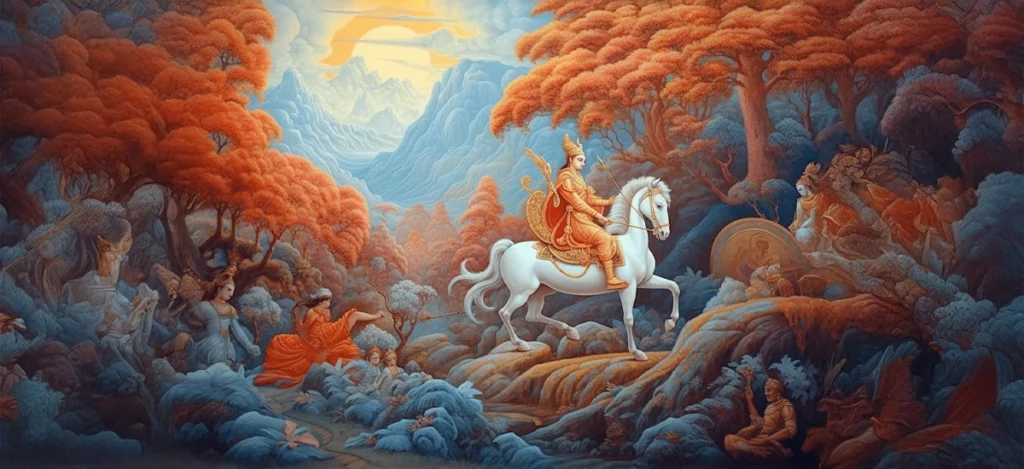

In the Bhagavad Gita, Krishna tells Arjuna:
“O mighty-armed Arjuna, the material energy consists of three gunas (modes)—sattva (goodness), rajas (passion), and tamas (ignorance). These modes bind the eternal soul to the perishable body.” (Bhagavad Gita 14.5)
These three modes or attributes are present in all manifestation to varying degrees.
All three gunas are qualities of material nature. They are not the Absolute, and however much we might try to cultivate sattva guna to support our spiritual practice, they are not the goal. Sattva is desirable only because the harmony and purity of this mode are a more direct reflection of the divine Reality and, in most cases, will lead us more safely and easily toward transcendence.
Tamas and rajas are conditions of deeper concealment in which it is harder to perceive the underlying truth of creation. They are modes of more severe separation and, as a result, suffering.
Tamas: The Mode of Ignorance
Tamas can be translated as “ignorance, inertia, or darkness.” It appears in the famous mantra from Brihadaranyaka Upanishad, in opposition to jyotir (light):
“asato ma sadgamaya
tamasoma jyotir gamaya
mrityorma amritam gamaya
OM shanti shanti shantihi.”
“From ignorance, lead me to truth;
From darkness, lead me to light;
From death, lead me to immortality
OM peace, peace, peace.”
It is the principle of entropy, decay, and dissolution of forms into base elements.
Tamas is traditionally symbolized by the buffalo, a lovely animal that does much to support humanity, but looking at one, you can understand the association. The Asian water buffalo is a massive creature, so heavily built that a cow (the icon of sattva guna) looks like a sprightly deer in comparison. They are generally dark in color, with rough skin and bristly hair in thin patches. Slow-moving and immensely powerful, they seem to have risen only barely out of the Earth itself.
Most of all, a buffalo loves to wallow. On a hot day, give it any amount of shallow, muddy water and it will happily lie there half-submerged for hours.
Tamasic consciousness also wants to wallow. It wants to go down, to submerge itself. It is heavy, difficult to change its course, and extremely difficult to reanimate once it has settled on something.
In tamas, the natural brilliance of Consciousness, the life of the universe, is obscured by the illusion of objective existence.
It’s the kind of energy that you feel a bit dirty after indulging in it, but at the time, it’s very hard to stop. These patterns tend to run deep, like old ruts in a dirt road.
And it’s primarily destructive, either outwardly violent or self-destructive.
The darker tendencies of human nature mainly stem from tamo guna: warfare and aggression but also addiction, depression, and suicide. Substance use (including an addictive approach to sex) to dull the mind and “escape” from reality is tamas—walk into a bar at 2 am and you’ll feel tamo guna in full force.
Yet these experiences hold a fascination for so many people because there is so much ignorance and alienation in our world. Our most basic drive is to seek happiness, which we know intuitively is our birthright. When this search is frustrated, as it inevitably will be if one tries to find happiness in external objects, one might fall into despair, for a short or a long time until the inner path opens up.
Rajas: The Mode of Restlessness
Rajas—“passion, agitation, activity”—has a contrary motion to tamas, although they might bleed into each other. (Rajasic seeking after new pleasures and experiences may turn tamasic when it becomes a dependency, at the point when you need more and more stimulation just to reach the same fulfillment.)
Rajasic consciousness is dynamic, grasping, and ambitious. It wants to build an empire of the go. Everything is very exciting and very important, but lacking a center.
Activity in itself is not a bad thing, but action in rajo guna is the opposite of Karma Yoga. It is characterized by attachment, desire, and identification with the outcome. There is no space for awareness or devotion.
Because of this, in the mode of rajas, you will tend to spiral outwards, hurtling at increasing speed towards one goal and then another. It’s the mode in which you will suddenly find yourself trying to accomplish 15 things simultaneously while having lost track of the one that really mattered.
Kali Durge Namo Namah
While the picture I have painted of rajas and tamas is (hopefully) quite unappealing, we should not forget that they are also part of the sacred manifestation. In the Hindu tradition, they even have their own divinity.
Among the Trimurti or Tridevi, the trinity of masculine or feminine deities, each divine form represents one of the gunas.
- Brahma/Sarasvati (creation)—rajas, the creative impulse moving out from a central point
- Vishnu/Lakshmi (preservation)—sattva, the stabilizing force that holds a balance between excessive action and inaction, pointing towards transcendence
- Shiva/Durga (destruction)—tamas, dissolution back into formlessness
The Goddess Kali is especially associated with tamas. The fiercest form of the Divine Mother, emanating from Durga as the Adishakti, Kali shows a terrifying appearance: night-black skin, blazing eyes, tongue extended, wearing a garland of skulls. In one hand, she holds a severed head; in another, a scimitar dripping with blood.
Historically, Kali worship was a bloody affair involving animal and sometimes human sacrifice. It remains so in some parts of India, where goats, buffalo, and other animals are slaughtered for Kali puja.
The Divine Mother, whose nature is Sat-Chit-Ananda (Existence-Consciouness-Bliss), comes in this dark form to connect with human beings whose consciousness is immersed in that frequency, and as a protector for those who need to confront the darker aspects of their being. She is the great purifier who devours and destroys all negative forces, the transformer and transmuter, cutting through all conceptions and burning away all which is opposed to truth.
Tantric Practices in Tamo Guna
Shaiva tantrics (worshippers of Shiva), such as the Aghori, are also known for their extreme practices. Smearing their naked bodies with cremation ashes, they meditate while sitting on top of corpses, drink alcohol and smoke cannabis, and engage in the occasional act of cannibalism, but not from any disturbed psychology or lurid fascination with the macabre.
Their methodology is rather to go unflinchingly into the practices most shocking to conventional sensibilities and reveal that Shiva, the Universal Consciousness, is there too.
In extremes of fear and repulsion, the mind can fall away, and Love shines through—absolute Love that embraces beauty and horror in equal measure.
Even in less extreme tantric paths (including the comparatively gentle and refined non-dual Shaiva Tantra of Kashmir), practitioners of left-hand Tantra would take part in the panchamakara (“five M’s”) ritual, consuming five tamasic substances that are forbidden in mainstream Vedic religion: alcohol, meat, fish, parched grains, and sexual intercourse.
These are valid paths. Still, they are not for everyone. These tantric practices were generally reserved for initiates with a very high level of consciousness and spiritual maturity; otherwise, it is too easy to fall through them into very dark places. It is a narrow path, offering both great rewards and great risks.
The Gift of Suffering
Living a clean and pure life, a sattvic life, will result in some happiness. You will be healthier, your mind lighter and clearer.
In Bhakti Yoga (and you will hear similarly in Buddhist teachings), they say that piety and religious observance, such as Vedic rituals, will result in mountains of good karma. Prosperity, longevity, good family life, and even rebirth in higher realms might be yours.
However, if it’s only piety without genuine devotion to God, that “burning of the heart” that Rumi declared more precious than a worldly empire, any amount of good karma is spiritually worthless.
The darker elements of human experience also have something valuable to teach us, if only as a strong motivator to move towards the light.
Sometimes, all the warnings in the world can’t turn you aside. You have to go to rock bottom before seeing that you’re headed for a dead end. But once you experience it for yourself, once you realize that absolutely, beyond question, you have nothing to gain from that particular indulgence, then you will never fall for its allure again.
Ultimately, you may see that you have nothing to gain from anything in the material world. At that point, you are free from all desires except the one desire that really matters: the desire for union with God, the true source of all happiness.
Naveen is a Hridaya teacher and a frequent contributor to our blog. You can read all of her posts here.