
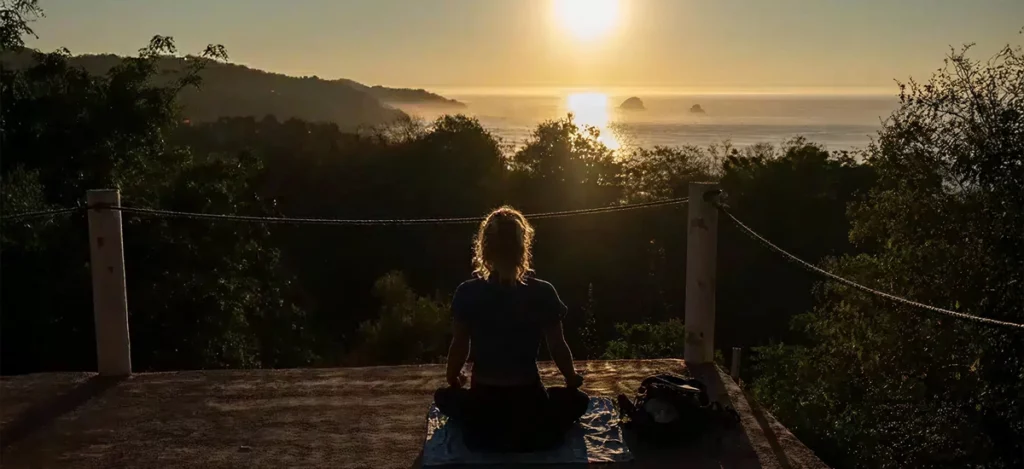

Burning of the Heart: The Inner Secret of Meditation
Sometimes the deepest transformations are the most subtle, and the most powerful prayer is the one that has no words, no form, and no direction except toward the Center of all centers.
Ecstasy can take many forms. It can bubble out as song or dance, laughter or tears. It can be a cry of joy or sweet agony. And it can also be very quiet. The pauses between breaths stretch into unbounded space as the silence of the mind merges with a greater silence.
Having once savored the bliss of meditation, you will not easily lose your taste for it, although it may at first come only in glimpses — a flash maybe like lightning or like the blinking light of a firefly that you just barely catch with the corner of your eye.
But you do catch it. At the very least, some intuition has been awakened. Some whisper is guiding you, though you may not understand what you are following or how you are able to trace its call.
Rupa Goswami’s Fire of the Heart
A story about Rupa Goswami, one of the founders of the Gaudiya Vaishnava movement, may be relevant to those on a path of meditation.
Once, at a gathering of devotees in Vrindavan, another leading acharya gave a lecture on Srimad Bhagavatam. It was a particularly stirring chapter in which the gopis sing their pain of separation from Krishna.
Everyone present was deeply touched. The devotees entered into the mood of the gopis, crying from intense longing for God until the ground was wet with tears.
Only one newcomer noticed that Rupa Goswami had not shed a single tear. Instead, he was sitting like a statue.
The new devotee was confused. Rupa was supposed to be the foremost among them; how was he the only one unmoved?
And when he went to investigate, to his alarm, it seemed that Rupa was not even breathing!
The newcomer held a piece of cotton under Rupa’s nose to check for signs of life. For a long time, the cotton was motionless. Then, finally, Rupa let out a breath — and the cotton caught fire.
What can we learn from this story? I would suggest a few inspirations.
Look beyond Appearance
First, look beyond externalities. It is impossible to judge another person’s spiritual progress from the outside and useless to compare it to your own. Every being has a unique relationship to the Divine and a unique expression within the tapestry of creation.
Even within your lifetime, you will pass through many different phases. Sometimes you may be in a movement of expression: creating, manifesting, and sharing.
At other times you might follow a different current: in search of solitude, withdrawal from the outside world in fascination with your interior landscape.
All of them are valid. What matters is to follow your authentic calling, which might be completely different from what everyone around you is doing and even what you expect of yourself.
Allow yourself the freedom to explore and heed the inspiration of the present moment. Your life can become deeply meaningful when you are in tune with this intuition. It will lead you into exactly what you need to experience, maybe not what you would consciously ask for but what is most beneficial for your growth.
Interiorization and Sublimation
During the 10-Day Hridaya Silent Meditation Retreat, we learn about four milestones in meditation: cessation of ordinary thinking, interiorization of the senses (pratyahara), sublimation of energies and emotions, and surrender.
The middle two of these — interiorization and sublimation — are intimately connected, resulting in the burning of the heart that Rupa exhibited.
Whatever you experience in meditation, try to draw it inwards. Thoughts, emotions, sense perceptions, pleasant or unpleasant, it doesn’t matter. Bring it toward the center of your being and allow it to vibrate there.
Even exalted emotions, like spiritual ecstasies that remain on the surface. Don’t go chasing states; don’t get swept away and think you’ve already made it to the top of the mountain — keep looking for something even more interior, even more intimate.
If you are steady and persistent, you will find that movement becomes a current that carries you toward the innermost chambers of the Heart.
And curiously, just through this interiorization, an alchemical transformation takes place. The emotions and perceptions, anything related to the external domain, start to dissolve back into pure vibration.
Pure but not inert — the current naturally flows towards God with such force that anything standing in its way is annihilated, like the cosmic Ganga pouring down from the heavens.
Passion and Equanimity
Finally, meditation should have passion. The heart is on fire!
Meditation instructions often emphasize relaxation, detachment, and non-reactivity. These attitudes are indispensable for deepening the practice.
Relaxation takes us out of the contractions of the thinking mind. Detachment and non-reactivity allow us to let go of what is irrelevant to our meditation, to transcend our limited beliefs and disturbing emotions, and ultimately to detach from the false sense of a separate “I” that is the root of all suffering.
Still, this should not imply coldness or indifference. As we turn away from the shadows of the world, we turn toward the dazzling radiance of God. We are at last turning to face our Beloved, the One we were truly looking for all our lives without realizing it. It is the culmination of a great love story — the beating heart of all love stories.
Shanta bhava, the first of the five bhavas or devotional attitudes in Bhakti Yoga, is a relationship with the Beloved characterized by peace, neutrality, and non-attachment.
While lacking the personal intimacy of later bhavas, shanta bhava is never cold. The fundamental quality of shanta bhava is a constant sense of awe and wonder at the Divine. Quiet amazement, so refined and close to the soul, free from any distraction or contraction of the mind around an object.
Equanimity is the key to realizing the splendor of the Infinite. In peace and stability, unshaken by the waves of thought and judgment, without imposing artificial distinctions of “good” and “bad,” we can see the beauty which infuses all creation.
And from here, we can go further to know this beauty within ourselves, to become so intimate with it, so familiar while always remaining unknown and unknowable, infinitely fascinating and ever presenting new facets at which we marvel.
Naveen is a Hridaya teacher and a frequent contributor to our blog. You can read all of her posts here.