
Order your copy of The Hridaya Cookbook! Explore this collection of plant-based recipes from our centers, and bring presence and intention to every meal.

“Of what use it would be to know everything else except about the subject to whom all knowledge relates?”
–Ramana Maharshi

At Hridaya Yoga, Ramana Maharshi is our revered spiritual master. He represents an embodiment of the Spiritual Heart itself, a manifestation of the Supreme Reality that is our True Nature.
His life is the very proof of the Truth of non-duality, Advaita, the oneness of Being, the background in which the illusion of separation dissolves like clouds in the blue sky.
His simple and profound teachings enliven the principles of Hridaya Yoga. They tenderly awaken a stream of unconditional love and inner silence that flows directly from the core of existence.
His gentle, eternal message will resonate even more vastly and deeply within the soul of humanity in the future.
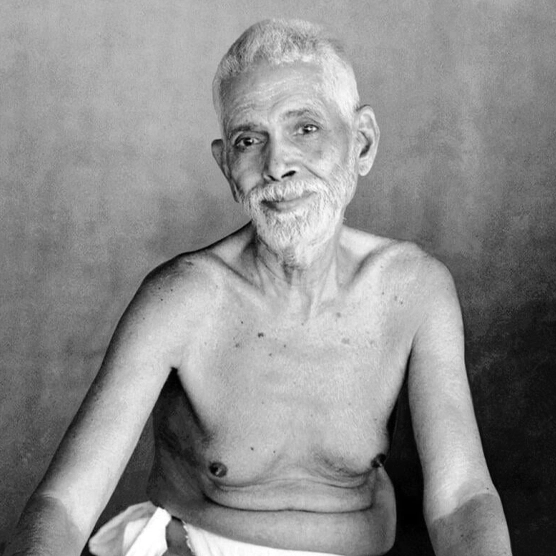
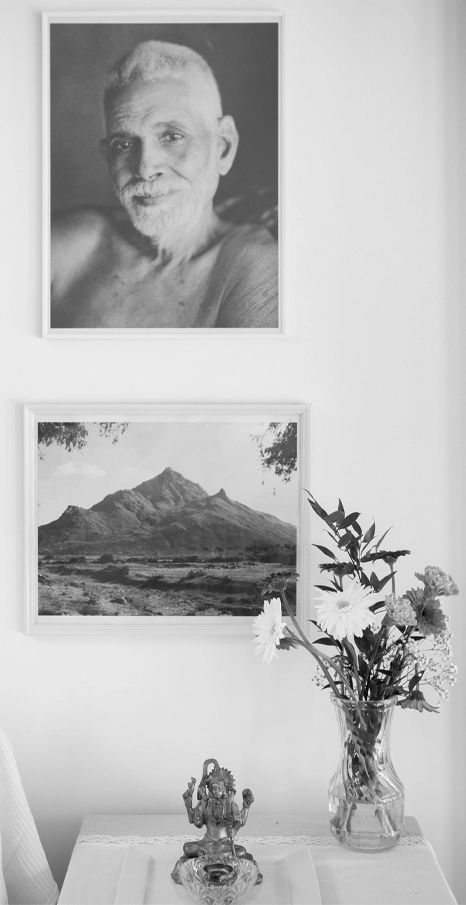
In iconography, there are canonical rules that explain how to represent the great saints and avatars of the past. For Ramana Maharshi, a unique, modern divine manifestation, we have a chance not encountered in previous centuries to connect more directly through photographs of Him. These serve as visual encounters with our beloved spiritual teacher’s radiant love and serenity; more than this, they are reflections of our True Self.
His eyes are like clear, edgeless mirrors through which the Self radiates, unobscured by any mental blurring. Ramana Maharshi offered the most profound initiation through their eloquent silence, an initiation that is available even now—evidence of our eternal nature. When we feel the ocean of compassion in His gaze, there is a natural trust in the depth and beauty of the Heart.
His luminous, smiling eyes teach us the exquisite secrets of Self-Inquiry. We learn to witness our thoughts and emotions in serenity and embrace our shadows.
In remembering Him, devotion arises naturally, since the mystery of His presence makes our soul come alive, vibrating as Self-awareness, spanda.
Ramana Maharshi’s teachings tell us to dive into the essence of the “I”-feeling, where we find wisdom, peace, conscious presence, and overwhelming love. They urge us to look beyond the illusions of the ego, shed its layers of separation, and rest in the Natural State, Sahaja. In such a new, liberating presence, we uncover an awareness so pure and all-encompassing that our existence becomes a hymn of gratitude, love, and joy.
The radiance of His silence is, in itself, a language deeper than words. Supreme Consciousness “speaks” its stillness through Him, and our soul listens in wonderment. Ramana Maharshi showed us that the spiritual journey is not about acquiring new knowledge meant to heal psychological struggles and quiet personal concerns, but about discovering the Truth and Love that have always been present deep within.
His instructions are like gentle waves washing over the shores of the personal domain, eroding the illusions that veil our Ultimate Nature.
Thus, the mind’s chatter fades away into the vast stillness of the Heart.
His pointers are so appealing because, in them, the reflection of inner Supreme Beauty shines, which, even when ignored for a long time, has never been really forgotten—a resonance that leads us to Hridaya.
Apart from the clarity of His insights, what inspires us is His perfect embodiment of Realization. In and through Him, the abstract becomes tangible; the spiritual path finds its grounding in love and clarity. He is the living demonstration of the possibility of moksha, spiritual liberation, not as a distant dream but as a present reality.
That’s why Ramana Maharshi’s presence in Hridaya is like a discreet whisper in the depths of our being, a subtle and unwavering reminder that we are not mere robots functioning mechanically in this world; we are the very essence of the journey, the Heart itself.
Ramana Maharshi invites us to remember our depths by constantly asking the question “Who am I?.” Self-Inquiry is the cornerstone of our practice. It’s like a key that unlocks the door to the sacred Heart; it’s a perpetual reminder of who we really are, the eternal presence in which all distinctions dissolve, revealing the infinite expanse of Consciousness both within and throughout the entire Cosmos.
In every murmur of wind caressing Arunachala Hill or any place on Earth, there is rasa, the blissful taste of Being, a melody of Divine Love that the Maharshi helped us hear— everything’s intrinsic Love-Being. His life offers evidence of such love, infusing us with the faith that we can also become instruments of universal Love and Compassion. He keeps making a heartfelt invitation to immerse ourselves in the silent wisdom of the Heart, live in perpetual devotion and freedom, and embody kindness in every gesture, word, and moment.
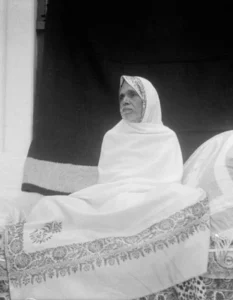
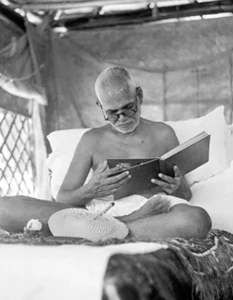
Sri Ramana’s guidelines reveal the sacredness of our soul, a realm of inner peace and transcendental beauty. They are like poetry awakening us to love, truth, and all the noble qualities within, to spanda, the vibrant, divine presence that animates every breath, every heartbeat.
His way was not marked by grandiose miracles or displays of paranormal powers but by the quiet beauty of simplicity. In His unassuming presence, we can feel that authentic paths are not about seeking external validation or miraculous signs but about turning inward with a love so deep, so unconditional that it transcends all boundaries of common understanding.
Like the moon’s quiet glow that asks for no applause, His life, free from chasing miraculous displays, speaks a truth that seeks no proof through spectacle but stands unwavering in its simplicity—the radiating power of love and kindness. The Divine doesn’t need glowing words or miracles; just trust and surrender to the Heart’s majesty. It’s the evidence of beauty in unadorned existence.
In today’s world, while pain, conflicts, and division become so obvious, discretely, a subtle longing for meaning and unity grows deeper in humanity. Ramana Maharshi’s guidelines are now so palpable because they are the eternal call to return to the very essence of our being. This direct wisdom of the Heart will help humanity envision and trust a world without separation, doubt, fear, or contempt—only an eternal embrace of Pure Consciousness, cradling all Life in its infinite love.
“Our own Self-realization is the greatest service we can render the world.”
–Ramana Maharshi
In our times, deep-seated intolerance and separation seem to haunt the world’s religions that, having forgotten their origins, display even more alienation. On the other hand, atheism boldly proclaims a life devoid of sacredness and deeper meaning. Ignoring symbolic language, skepticism challenges the old anthropomorphic descriptions of divinity and rituals.
Because of all this, especially now, the Maharshi’s simple and direct teachings have emerged like a flame of hope and spiritual support for the world.
The Universal, Eternal Truth of Being is in itself Peace, Love, and Beauty. This is what we are, beyond the walls of our fears and hates, beyond dogmatic atheism or sectarian religions. The Heart is the unifying reality that shows us how we are all part of this same fascinating mystery that is Life itself.
Ramana Maharshi’s teachings are meant to heal today’s fragmented world, where souls often feel confused, isolated, lost, traumatized, and misunderstood.
The Maharshi’s revelations are not about a God seated high above or distant and detached, but an invitation to reveal godliness inside.
The Divine, often perceived in the contemporary world as distant or absent, is not lost but waiting to be discovered in the unfathomable depths of our being. The absence of a tangible, definable God leads us not to emptiness or atheism but to an uplifting spiritual longing, a yearning for connection with the “living God,” an all-encompassing Love that exists beyond the confines of human perception and understanding. This realization is not a denial of God but an intimate knowledge, jnana, of a mystery so profound and all-embracing that it transcends all conventional understanding.
Ramana Maharshi’s revelations and grace point not to a God to be grasped by the mind’s frail capabilities, imagination, dogmas, or wishful thinking, but in wonderment in front of a presence too vast, too intimate to be merely understood with the mind. The intellect alone cannot seize the true essence of divinity. It can be disclosed through Self-Inquiry meditation in the stillness of the Heart.
We express gratitude to Ramana Maharshi, our spiritual master. His inspirations are a perennial source of wisdom, leading us back home to Hridaya, the Heart.
In the spirit of the non-dual teachings, Advaita, Ramana Maharshi is our innermost sacred being, the Divine Self.
Therefore, honoring Him, we celebrate our True Nature, the eternal essence of all life, in which samsara and nirvana are inseparably united. In the mystery of devotion for Him, there is the journey and the destination, the miracle of the individual becoming one with the universal.
The greatest praise we can offer is to embody the very essence of His teachings, to dive within and discover the boundless love and peace that reside in the Heart. In doing so, we honor not just a sage but the timeless Truth he so gracefully revealed; we revere the journey towards the Heart and the Heart itself, Hridaya, the eternal truth within us.
May Sri Ramana’s loving remembrance and His guidance ignite the flames of wisdom, devotion, kindness, and love within us!
May our appreciation of Him become tangible as we spread the light of love and unity in a world aching for this touch!
At the young age of sixteen, when He was not even aware of the fact ‘This is the spiritual practice of Self-Inquiry that directly bestows the experience of the Self’, it so happened one day that, without any prior intention, Sri Ramana embarked upon this rare spiritual practice!
On that day as if He were about to die, a great fear of death possessed Him all of a sudden. Because of it, an impulse to scrutinize death also arose in Him spontaneously. He was not perturbed to see the fast-approaching death, nor did He feel inclined to inform others about it! He decided to welcome it calmly and to solve the problem all alone. He lay down, stretching His limbs like a corpse, and began to scrutinize death practically, face to face.
‘All right, death has come! What is death? What is it that is dying? It is this body that is dying; let it die!’ Deciding thus, closing the lips tightly and remaining without breath or speech like a corpse, what came to my knowledge as I looked within was: ‘This body is dead. Now it will be taken to the cremation ground and burnt; it will become ashes. All right, but with the destruction of this body, am I also destroyed? Am I really this body?
Although this body is lying as a speechless and breathless corpse, undoubtedly I am existing, untouched by this death! My existence is shining clearly and unobstructed! So this perishable body is not ‘I’! I am verily the immortal ‘I’ (Self)! Of all things, I alone am the reality! This body is subject to death; but I who transcend the body am eternally living!’ Even the death that came to the body was unable to touch me!
Thus it dawned directly, and along with it the fear of death that had come at first also vanished, never to appear again! All this was experienced in a split second as direct knowledge and not as mere reasoning thoughts. From that time onwards, the consciousness of my existence transcending the body has ever continued to remain the same.” (From ‘The Path of Sri Ramana’, Part One, Chapter 8 – Sadhu Om)
One day I sat up alone on the first floor of my uncle’s house. I was in my usual health. I seldom had any illness. I was a heavy sleeper. … So, on that day as I sat alone there was nothing wrong with my health. But a sudden and unmistakable fear of death seized me. I felt I was going to die.
Why I should have so felt cannot now be explained by anything felt in my body. Nor could I explain it to myself then. I did not however trouble myself to discover if the fear was well grounded. I felt ‘I was going to die,’ and at once set about thinking out what I should do. I did not care to consult doctors or elders or even friends. I felt I had to solve the problem myself then and there.
The shock of fear of death made me at once introspective, or ‘introverted’.
I said to myself mentally, i.e., without uttering the words – ‘Now, death has come. What does it mean? What is it that is dying? This body dies.’
I at once dramatized the scene of death. I extended my limbs and held them rigid as though rigor-mortis had set in. I imitated a corpse to lend an air of reality to my further investigation. I held my breath and kept my mouth closed, pressing the lips tightly together so that no sound might escape. Let not the word ‘I’ or any other word be uttered!
‘Well then,’ said I to myself, ‘this body is dead. It will be carried stiff to the burning ground and there burnt and reduced to ashes. But with the death of this body, am “I” dead? Is the body “I”? This body is silent and inert. But I feel the full force of my personality and even the sound “I” within myself, – apart from the body. So “I” am a spirit, a thing transcending the body. The material body dies, but the spirit transcending it cannot be touched by death. I am therefore the deathless spirit.’
All this was not a mere intellectual process, but flashed before me vividly as living truth, something which I perceived immediately, without any argument almost. ‘I’ was something very real, the only real thing in that state, and all the conscious activity that was connected with my body was centered on that.
The ‘I’ or my ‘self’ was holding the focus of attention by a powerful fascination from that time forwards.
Fear of death had vanished once and forever. Absorption in the Self has continued from that moment right up to this time.
Other thoughts may come and go like the various notes of a musician, but the ‘I’ continues like the basic or fundamental sruti note which accompanies and blends with all other notes.
Whether the body was engaged in talking, reading or anything else, I was still centred on ‘I’.
(Ramana Maharshi: His Life, Gabriele Ebert)
What Is Dhyana—Meditation?
D: What is dhyana?
M: The word dhyana usually signifies meditation on some object, whereas nididhyasana is used for enquiry into the Self. The triad persists until the Self is realized. Dhyana and nididhyasana are the same for the aspirant, because they involve the triad and are synonymous with bhakti.
***
D: What is dhyana?
M: Dhyana is holding to a single thought and setting aside all other thoughts.
D: How should dhyana be practiced?
M: Dhyana serves to concentrate the mind. The predominant idea keeps the others away. Dhyana varies according to the individual. It may focus on an aspect of God, on a mantra, or on the Self, etc.
***
D: Is that dhyana?
M: To remain in a position unassailed by thoughts is practice—you are watchful. The condition grows more intense and deep when effort and all responsibilities are taken from you; that is Aroodha, the state of Siddhi.
***
D: How to meditate?
M: Concentrate on the one you love most. If a single thought prevails, all other thoughts are set aside and finally eliminated. So long as diversity prevails, undesirable thoughts appear. When the object of love dominates, only good thoughts prevail. Therefore, hold to one thought alone. Dhyana is the chief practice.
Dhyana means a fight. As soon as you begin to meditate, other thoughts gather, gain force, and try to sink the single thought you are holding.
The good thought must gradually gain strength through repeated practice. Once it is strong, the other thoughts take flight. This is the battle royal that always takes place during meditation.
One wants to be free from misery. That requires peace of mind—freedom from disturbance caused by thoughts of every kind. Peace of mind is brought about by dhyana alone.
***
D: Meditation is with the mind. How can it subdue the mind to reveal the Self?
M: Meditation sticks to one thought. That single thought keeps other thoughts away; distraction is a sign of the mind’s weakness. By constant meditation it gains strength; the weakness of fugitive thoughts gives way to an enduring background free from thoughts. This expanse devoid of thought is the Self. Mind in its purity is the Self.
***
D: How is meditation to be practiced?
M: Strictly speaking, meditation is to be fixed as the Self. When thoughts cross the mind and effort is made to eliminate them, that effort is commonly called meditation. Stillness in the Self is your real nature. Remain as you are. That is the aim.
D: But thoughts arise. Is our effort only to eliminate thoughts?
M: Yes. If meditation remains on a single thought, the other thoughts are kept away.
D: We are asked to fix the mind in the Self, but the Self is unthinkable.
M: When all thoughts are eliminated, the mind becomes fixed in the Self.
***
Atma Vichara – Self-Inquiry Using the Question “Who am I?”
D: How is vichara to be done?
M: The questioner must admit the existence of his Self. “I AM” is Realization. To follow that clue until Realization is vichara. Vichara and Realization are the same.
D: It seems elusive. What should I meditate upon?
M: Meditation requires an object, whereas in vichara there is only the subject, without an object. In this way meditation differs from vichara.
***
D: Will vichara alone suffice in the absence of meditation?
M: Vichara is both the process and the goal. “I AM” is the goal and the final Reality. To hold to it with effort is vichara; when spontaneous and natural, it is Realization.
D: In my meditation I try to eliminate the false “I,” but so far without success.
M: How can “I” eliminate itself? All you need do is find its source and abide there as your real Self. Your efforts can go this far; the Beyond will take care of the rest.
***
D: Bhagavan, you always say the Self is ever-present. If I am present, why don’t I feel it?
M: Do you not now feel that you exist? Your doubt is whether you will continue to exist forever. Why should you doubt? A little reflection will convince you that the perishable part of your being—the body—is only a machine, a tool serving the imperishable, the mind, which is the knower and master—yourself. Your doubts and difficulties arise from thoughts that perceive the body and take it to be yourself. Stop the thoughts—the ego, your enemy—and the mind will remain as your pure being, the immortal “I.”
***
D: How to reach that center where what you call “Consciousness”—the “I-I”—arises? Is it by simply thinking “Who am I?”
M: Yes. It will lead you there. Do it with a calm mind; inner tranquility is essential.
D: How does that consciousness manifest when that center—the Heart—is reached? Will I recognize it?
M: Certainly—as pure consciousness, free of thought. It is unbroken awareness of your Self, or rather of pure Being—impossible to mistake when pure.
***
D: If I keep rejecting thoughts, may I call it vichara?
M: It can be a preliminary step. Truly, vichara begins when you cling to your Self and are already free from mental movement—the waves of thought.
D: Then vichara is not intellectual?
M: No. It is an inner quest.
***
D: Isn’t meditation better than investigation?
M: Meditation implies mental imagery, whereas investigation concerns Reality. The former is objective; the latter is subjective.
***
D: What are the hindrances to Self-realization?
M: Chiefly memory, habits of thought, and accumulated tendencies.
D: How does one get rid of these hindrances?
M: Seek the Self by meditation in this way: trace every thought to its origin—the mind. Never let thought run on; otherwise it becomes endless. Bring it back to its starting point again and again, and the mind will die of inaction. Constantly return to the question “Who am I?” Strip everything away until only the source of all remains. Then live always in the present. There is no past or future except in the mind.
***
Atma-Vichara and Grace
D: Then I can dispense with outside help and, by my own effort, reach the deeper truth by myself?
M: True. But the very fact you are possessed by the quest for the Self is itself the manifestation of divine grace. It shines in the Heart—the inner being, the real Self. It draws you from within; you strive from without. Your effort is vichara (earnest quest); the deep inner movement is Grace. Therefore there is no real vichara without Grace, nor active Grace for one without vichara. Both are necessary.
***
The Purpose of Life
D: What is the paramount duty of a human being caught in the cycle of births and deaths? Choose one and expound it to me.
M: For those who aspire to the highest, discerning one’s true nature matters most. It is the basis of all actions and their fruits.
D: Briefly, by what spiritual practice does one become aware of one’s true nature? What effort brings about the exalted inner vision?
M: By withdrawing all thoughts from sense-objects through effort, one should remain fixed in steady, non-objective inquiry.
***
Thoughts During Meditation
D: Other thoughts arise more forcefully when one attempts meditation. (Several others ask similar questions.)
M: Yes, all kinds of thoughts arise during meditation. That is natural. What lies hidden in you is brought out. Unless they arise, how can they be destroyed? They arise spontaneously to be extinguished in due course, thereby strengthening the mind.
***
Meditation with Form—God; Mantras
D: What should one meditate upon?
M: Whatever you prefer.
D: Siva, Vishnu, and Gayatri are said to be equally efficacious. Which should I meditate upon?
M: Whichever you love most. All are equal in effect, but you should stick to one.
***
D: Something concrete is needed to meditate upon. How shall we meditate on “I”?
M: We have become rooted in forms and therefore require a concrete form for meditation. In the end, only what we contemplate remains.
When you contemplate, other thoughts disappear. As long as contemplation is needed, there are other thoughts.
Where are you? You contemplate because you exist; the contemplator must contemplate. Contemplation can only occur where he is.
Contemplation wards off other thoughts. You should merge in the source. At times we merge unconsciously—as in sleep, death, or fainting.
What is contemplation? Consciously merging into the source. Then the fear of death or fainting disappears, for you can merge consciously into the source.
***
D: What is the best way to meditate?
M: Do you practice japa with beads?
D: No.
M: Have you reflected on God and His qualities, etc.?
D: I have read and spoken about such themes.
M: If the same reflections revolve in the mind without outward expression through the senses, that is meditation.
D: I mean meditation as indicated in The Secret Path and “Who am I?”
M: After camphor burns away, no residue remains. The mind is the camphor; when it resolves into the Self without leaving even the slightest trace, that is Realization of the Self.
***
D: In meditation, are there words to be repeated mentally?
M: What is meditation but mental repetition of a concept? It is a mental japam that begins with words and ends in the Silence of the Self.
***
D: I am taught that mantra japam is very potent in practice.
M: The Self is the greatest of all mantras and goes on automatically and eternally. If you are not aware of this inner mantram, begin consciously—like japam—making the effort to ward off other thoughts. With steady attention, you will eventually become aware of the inner mantra, which is the state of Realization, effortless.
Firmness in this awareness, gained through repeated practice, will enable your mind to hold the current uninterruptedly and effortlessly, even while engaged in outward activity. Listening to Vedic chanting or similar mantras has the same effect as conscious japam—their rhythm is japam.
***
D: Will Gayatri help?
M: What is Gayatri? It truly means: “Let me concentrate on that which illumines all.” Dhyana really means only concentrating or fixing the mind on the object of dhyana.
But meditation is our real nature. When we give up all other thoughts, what remains is “I,” whose nature is dhyana (meditation) or jnana (knowledge), whichever name we choose. What is at one time a means later becomes the end; unless meditation (dhyana) were the nature of the Self, it could not take you to the Self. If the means were not of the nature of the goal, it could not bring you to the goal.
***
D: May I use forms and images of God, as well as mantras?
M: Yes, of course. All these can help—why else would the scriptures recommend them? Different practices suit different natures. Each person must choose what is easiest and most appealing.
***
D: I have faith in murti dhyana (worship of form). Will it not help me gain jnana?
M: Certainly. Upasana (devotional practice) helps concentrate the mind. Then the mind is freed from other thoughts and filled with the contemplated form. The mind becomes that form and is purified. Then ask: who is the worshipper? The answer is “I,” the Self. Ultimately, the Self alone is attained.
***
D: I fall into a trance when I see a blank sky.
M: He who sees the blank is the Self.
***
D: Self-inquiry is so hard to understand. If something concrete is indicated, it’s easier to grasp. Japa, dhyana, etc., are more concrete.
M: “Who am I?” is the best japa.
What could be more concrete than the Self? It is present in everyone’s experience at every moment. Why seek anything outside, leaving aside the Self? Let each one discover the known Self instead of searching for some unknown beyond.
***
The Control of the Mind
D: Meditation is possible only with control of the mind, which can be achieved only through meditation. Is this not a vicious circle?
M: They are interdependent. In fact, meditation includes mind-control—the subtle watchfulness against intruding thoughts. At first, effort to control is greater than for meditation itself; in time, meditation prevails and becomes effortless.
***
D: How to check the mind?
M: Will a thief hand over a thief? Can the mind find itself? The mind cannot seek the mind. You ignore the Real and cling to the mind, which is unreal, yet try to discover what it is. Was there mind in your sleep? No. It is here now; therefore it is impermanent. Can you find the mind? The mind is not you. You think you are the mind, and therefore ask how to check it. If it were there, it could be checked—yet it is not. Understand this by inquiry. Seeking unreality is useless. Seek Reality—the Self. That is how to rule the mind.
There is only one Reality; the rest are appearances. Diversity is not its nature. We read printed characters on paper but ignore the paper that supports them. Likewise, you are taken up by the manifestations of mind and overlook the background. Whose fault is that? The essence of mind is only awareness—consciousness. When the ego dominates, it functions as thinking, reasoning, or sensing. The cosmic mind, not limited by ego, has nothing apart from itself and is therefore only awareness.
***
The Cosmic Mind and Mauna
D: How is one to be aware of the cosmic mind?
M: Hold the mind firmly and trace it back to its source. By concentration, mauna (silence) results. When practice becomes natural, it culminates in mauna. Meditation without mental activity is mauna. The merging of the mind in its source is meditation; deep meditation is the eternal speech.
***
Pranayama and Meditation
D: I work hard and find little time to practice concentration. Are there any aids? Is control of breath a good aid?
M: Prana and mind arise from the same source. That source can be reached by holding the breath or by tracing the mind. If the latter is difficult for you, the former will help. Breath regulation is gained by watching its movements. If the mind is watched, thoughts cease. Peace results—your true nature.
King Janaka said, “I have now found the robber (the mind) who has been robbing me of my ‘I-ness.’ I will instantly kill this thief.” The disturbance caused by thoughts seems to rob the Self of its peace. That disturbance is the mind. When it ceases, the mind is said to have taken flight. The Self remains as the unmoved substratum.
***
D: Is breath-control necessary for inquiry?
M: Not exactly.
D: The book says, “There is a blankness intervening.”
M: Yes. Do not stop there. See for whom the blankness appears.
D: It is said that for devotees there is no blankness.
M: Even then, there is the latent state—laya; the mind wakes again after some time.
***
Hatha Yoga and Self-Inquiry (Atma Vichara)
D: Is Hatha Yoga necessary?
M: It is one aid—not always necessary. It depends on the person. Vichara surpasses pranayama. In the Yoga Vasistha, Chudala advises vichara to Sikhidvaja to destroy the ego. Reality can be reached by holding to prana or to intellect. Hatha Yoga belongs to the former; vichara to the latter.
***
Falling Asleep in Meditation
D: How can one avoid falling asleep during meditation?
M: Sleep must be overcome, for the natural state is to be consciously attained in jagrat (the waking state). Waking and sleep are mere pictures on the screen of the native, thought-free state.
***
Meditation and Self-Inquiry
D: What is the difference between meditation and Self-inquiry?
M: Meditation is possible only if the ego remains—there is the ego and the object meditated upon. The method is indirect. The Self is one. Seeking the ego—its source—the ego disappears; what remains is the Self. This method is direct.
D: Then what should I do?
M: Hold to the Self.
D: How?
M: Even now you are the Self. But you confound this limited consciousness (ego) with absolute Consciousness. This false identification is due to ignorance, which vanishes with the ego. The only task is to end the ego. Realization already is. No effort is needed to “attain” it, for it is nothing external or new. It is always and everywhere—here and now.
***
D: What is the one thing which, when known, resolves all doubts?
M: Know the doubter. If the doubter is held, doubts do not arise. To uproot doubt is to uproot the doubter—the mind.
D: What is the method?
M: “Who am I?” is the inquiry.
D: May we perform japa?
M: Why think “I am this”? Inquire, and thoughts cease. What is—the Self—stands revealed as the inescapable residue.
***
Self-Inquiry vs. Meditation on Chakras
D: I am a beginner in meditation and pray to Bhagavan to guide me. You urge us to keep asking “Who am I?” Where will it lead me?
M: It is not mere asking; you must go to the meaning. Many meditate on certain centers of the body until they merge there, but sooner or later they must inquire into their own nature—that is inevitable. Why not directly concentrate on yourself until you merge in your source?
D: For twenty years I have concentrated on certain chakras, seeing forms and hearing sounds, yet I am no nearer the Truth. Should I now keep asking “Who am I?” whenever a thought arises?
M: Precisely. So long as you are not disturbed by external thoughts, dwell on the meaning. The aim is to reach the root of the “I”-sense without disturbance.
***
Fixing the Attention in Ajna Chakra
D: We are advised to fix attention on the point in the forehead between the eyebrows. Is that right?
M: Everyone is aware, “I am.” Leaving that awareness, one searches for God. What is the use of fixing attention between the eyebrows? It is folly to say God is there. The point of such advice is to help concentration—one of the forcible methods to check the mind and prevent dissipation by channeling it into one stream. It is a help to concentration, but the best means of Realization is the inquiry “Who am I?” The present trouble belongs to the mind and must be removed by the mind itself.
***
Closing the Eyes
D: Does closing the eyes during meditation have any efficacy?
M: Eyes may be open or closed, as convenient. It is not the eyes that see—there is one who sees through the eyes. If turned inward and not looking through the eyes, they may be open and yet nothing is seen. If we keep the eyes closed, it is the same to us whether the room’s windows are open or shut.
***
Mosquito Bites
D: If there is disturbance during meditation, such as mosquito bites, should one persist and ignore it, or drive the mosquitoes away and then continue?
M: Do as is most convenient. You will not attain mukti simply by refraining from driving them away, nor be denied it by doing so. The point is to attain one-pointedness and then mano-nasa (destruction of mind). Whether you reach it by bearing the bites or by driving the mosquitoes away is up to you. If you are wholly absorbed, you will not even know you are being bitten. Until you reach that stage, why not drive them away?
***
Doing vs. Being
D: How to do all this?
M: The lack of the feeling that we are the Self is the root of the trouble. Drop thoughts and be—simply be. Thoughts alone create the obstacle; they are the trouble. Find out to whom thoughts occur. So long as you believe an individual self exists, it appears to do so; but find where it arises, and it vanishes. Those who discovered great Truths did so in the still depth of the Self.
***
Headaches in Meditation
D: I get a headache if meditation is prolonged. What should I do?
M: If the meditator and meditation are understood to be the same, there will be no headache or similar complaints.
D: But they are different. How can we consider them the same?
M: That depends on your outlook. There is only One, with no differences. In meditation, relative consciousness disappears. That is not annihilation; absolute Consciousness arises. The Bible itself says, “The Kingdom of Heaven is within you.” If you consider yourself the body, that statement is hard to grasp. Know who you truly are, and the Kingdom of Heaven and all is found in your true Self.
***
D: Bhagavan, whenever I meditate I feel great heat in the head, and if I persist, my whole body burns. What is the remedy?
M: If concentration is made with the brain, heat and even headache may ensue. Concentration should be in the Heart, which is cool and refreshing. Relax and meditation becomes easy. Keep the mind steady by gently warding off intrusive thoughts, without strain—soon you will succeed.
Ramana Maharshi shares the following wisdom about meditation and overcoming thoughts:
M: In meditating on an object—whether concrete or abstract—you destroy the sense of oneness and create duality.
D: What meditation would help me?
M: No meditation on any kind of object is helpful. You must realize that subject and object are one. In meditating on an object—whether concrete or abstract—you destroy the sense of oneness and create duality. Meditate on what you are in reality… you will find…
D: What?
M: You will discover. It is not for me to say what an individual experience will be; it reveals itself. Hold to it.
***
D: You often say one must reject other thoughts when beginning the quest, but thoughts are endless. If one is rejected, another comes; there seems to be no end.
M: I do not say you must keep rejecting thoughts. If you cling to yourself—the “I”-thought—and your interest keeps you to that single idea, other thoughts are rejected automatically; they vanish.
D: So rejection of thoughts is not necessary?
M: No. It may be necessary for a time, or for some. You imagine there is no end if you go on rejecting every thought as it arises. Not so—there is an end. If you are vigilant and make a firm effort to reject each thought when it arises, you will soon find yourself going deeper into your own inner Self, where effort to reject thoughts is no longer needed. The effort is sublimated into simple awareness of the Self.
D: Then it is possible to be without effort!
M: Indeed; and beyond a certain point it is impossible to make any effort.
D: I wish to understand further. Should I try to make no effort at all?
M: At first, it is impossible to be without effort. Deeper within, it is impossible to make any effort.
Ramana Maharshi shares the following insights about meditation:
D: How is one to meditate?
M: What is meditation? It is commonly understood to be concentration on a single thought. Other thoughts are kept out at that time. The single thought also must vanish at the right time—thought-free consciousness is the goal.
***
D: How can meditation become steady?
M: What is meditation? It consists in expelling thoughts. All the present troubles are due to thoughts and are themselves thoughts. Give up thoughts—that is happiness and also meditation. Thoughts exist only for the thinker. Remain as the Self of the thinker, and thoughts will end.
***
D: Is the state of unconsciousness close to infinite being?
M: Consciousness alone exists.
He who knows the Self has nothing more to do. Henceforth the Infinite Power will perform all necessary actions through him. Nor has he any more thoughts.
During meditation directed toward the Self, thoughts naturally die down of their own accord. Meditation can be directed to different objects, but when directed toward the true Self, it turns to the subject.
When we are free of thoughts, we are naturally blissful. The gap between two thoughts is our true state—it is the real Self. Get rid of thoughts, be empty of them, live in a state of perpetual thoughtlessness. Then you are consciously Self-existent. Thoughts, desires, and all qualities are alien to our true nature. The West may praise a man as a great thinker—but what is that? True greatness is to be free of thoughts.
The true answer to the question “Who am I?” does not come in thoughts. All thoughts disappear—even the thinker himself disappears.
***
D: How can the mind be made to go?
M: No attempt is made to destroy it. To think or to wish is itself a thought. If the thinker is sought, the thoughts will disappear.
D: Please give me some more details about the Heart and its movements.
M: The Heart is the seat of knowledge and the knot of ignorance. It is represented in the physical body by a hole smaller than the smallest pin-point, which is always shut. When the mind drops down in ‘Kevala Nirvikalpa’, it opens, but shuts again afterward. When sahaja is attained, it opens for good.
The knot that ties the insentient body to the consciousness functioning within it is the “knot of ignorance.” That is why, when it is loosened temporarily—as in Kevala Nirvikalpa—there is no body consciousness. I used to feel the vibrations of the Heart, resembling those of a dynamo, even in school. When I developed rigor mortis many years ago in Tiruvannamalai, every object and sensation disappeared except these vibrations. It was as if a dark screen were drawn before my eyes and shut the world completely from me. Yet, I was all along conscious of the Self, with a vague feeling that someone was crying near me. This state continued until just before I regained physical consciousness, when I felt something rush from the Heart to the left chest and re-establish life in the body. A sudden fear, joy, or shock makes the Heart vibrate very forcefully, so that it can be felt by anyone who pays attention to it. Otherwise, it is felt only in Samadhi.
D: Does the enquiry “Who am I?” lead to any spot in the body?
M: All self-consciousness is in relation to the individual himself, and therefore has to be experienced in his being, with a centre in the body as the centre of experience.
It resembles the dynamo of a machine, which gives rise to all sorts of electrical functions. Not only does it maintain the life of the body and the activity of all its parts and organs, conscious and unconscious, but also the relation between the physical and subtler planes on which the individual functions.
Also, like the dynamo, it vibrates and can be felt by the calm mind that pays attention to it. It is known to yogis and seekers by the name “sphurana”—the Heart’s “I-I” throb ever scintillating with consciousness in the natural state.
D: Is the vibratory movement of the Centre felt simultaneously with the experience of Pure Consciousness, or before or after it?
M: They are one and the same. But sphurana can be felt subtly even when meditation has sufficiently stabilized and deepened and the Ultimate Consciousness is very near—or during a sudden great fright or shock, when the mind comes to a standstill. It draws attention to itself so that the meditator’s mind, rendered sensitive by calmness, may become aware of it, gravitate toward it, and finally plunge into the Self.
D: What is sphurana (a kind of indescribable but palpable sensation in the Heart Center)?
M: Sphurana is felt on several occasions—such as in fear, excitement, and so on. Although it exists always and everywhere, it is felt at a particular center and on particular occasions.
It is also associated with antecedent causes and confounded with the body; whereas it is all alone and pure—it is the Self. If the mind is fixed on the sphurana and one senses it continuously and automatically, that is realization.
“Sphurana” is pure. The subject and object proceed from it. If a person mistakes himself for the subject, objects must necessarily appear different from him. They are periodically withdrawn and projected, creating the world and the subject’s enjoyment of it. If, on the other hand, one is aware that the light which makes perception possible is the screen on which the subject and object are projected, there can be no confusion. One can then remain watching their appearance and disappearance without any perturbation of the Self.
D: What is the nature of the Heart? Does the Spiritual Heart beat? If it does not beat, then how is it to be felt?
M: This Heart is different from the physical heart; beating is the function of the latter. The former is the seat of spiritual experience—that is all that can be said of it. Just as a dynamo supplies motive power to whole systems of lights, fans, and so on, so the original Primal Force supplies energy to the beating of the heart, respiration, and all vital functions.
Ramana Maharshi shares the following insights about surrender:
Q: Surrender is impossible.
A: Yes, complete surrender is impossible in the beginning. Partial surrender is certainly possible for all. In the course of time, that will lead to complete surrender.
***
Q: Partial surrender—well—can it undo destiny?
A: Oh, yes! It can.
***
Q: How can I gain that peace of mind?
A: Through devotion and surrender. Bhakti is the same as vichara. The form and appearance of God-manifestation are determined by the mind of the devotee—but that is not the finality. There remains the sense of duality. A Higher Power is leading you; be led by that same Power. It knows what to do and how to do it. Trust it.
***
Q: How is Grace to be obtained?
A: Similar to obtaining the Self.
Q: Practically, how is it to be done for us?
A: By self-surrender. Bhakti and Self-Enquiry are one and the same. The Self of the Advaitins is the God of the bhaktas. All systems agree on self-surrender. Attain it first.
***
Surrender will make one understand Grace. Grace is constant.
Q: How to gain Divine Grace?
A: By surrender.
Q: Still, I do not feel Grace.
A: Sincerity is wanting. Surrender should not be verbal nor conditional. Prayer is not verbal—it is from the heart.
***
Grace is both the beginning and the end. Introversion is due to Grace; perseverance is Grace; and realization is Grace. That is the reason for the statement “Only surrender to Me.” If one has entirely surrendered oneself, is there any part left to ask for Grace? Surrender yourself unreservedly and the Higher Power will reveal itself. Either the thoughts are eliminated by holding on to the root thought “I,” or one surrenders oneself unconditionally to the Higher Power. These are the only two ways for realization.
It is not enough that one thinks of God while doing karma; one must continually and unceasingly think of Him. Then alone will the mind become pure. God cannot be deceived by outward genuflections, bowings, and prostrations. Leave it to Him. Surrender unreservedly. One of two things must be done: either surrender because you admit your inability and require a Higher Power to help you, or investigate into the cause of misery, go into the source, and merge into the Self. Either way, you will be free from misery. God never forsakes one who has surrendered.
***
Q: Can Sri Bhagavan help us to realize the Truth?
A: Help is always there.
Q: I do not feel the ever-present help.
A: Surrender and you will find it.
Q: Can I throw myself at the mercy of the Sadguru?
A: Yes. Instructions are necessary only so long as one has not surrendered oneself. Surrender to Him and abide by His will, whether He appears or vanishes—await His pleasure. If you ask Him to do as you please, it is not surrender but command to Him. You cannot have Him obey you and yet think that you have surrendered. He knows what is best—when and how to do it. Leave everything entirely to Him. His is the burden; you have no longer any cares. All your cares are His. Such is surrender. This is bhakti. Surrender can take effect only when done with full knowledge. Such knowledge comes after enquiry; it ends in surrender.
***
There are two ways: either ask yourself, “Who am I?” or submit. Submit to Me and I will strike down the mind. There is no better karma or bhakti than enquiry into the Self. The second path is the way of self-surrender—the way of sharanagathi. Surrender yourself to the universal, and you will be absorbed in the universal.
***
Surrender is complete only when you reach the stage “Thou art all” and “Thy will be done.” You can have no likes or dislikes after surrender; your will should become completely non-existent, the Lord’s will taking its place. The death of the ego in this way brings about a state not different from jnana or oneness. So by whatever path you may go, you must come to jnana.
***
When one has completely surrendered oneself at the feet of Siva, thereby becoming of the nature of the Self, the resulting abundant peace—in which there is not even the least room within the Heart for one to make any complaint about one’s defects and deficiencies—alone is the nature of Supreme devotion.
***
The end of sadhana, even in bhakti marga (the path of devotion), is attained only after complete surrender.
***
You give up this and that of “my” possessions. If you give up “I” instead, all are given up at a stroke. The very seed of possession is lost. Thus, the evil is nipped in the bud or crushed in the germ itself. Dispassion (vairagya) must be very strong to do this. The eagerness to do it must be equal to that of a man kept under water trying to rise to the surface for his life.
***
If you remember Bhagavan, you are prompted to do so by the Self. Is not Grace already there? The very fact that you are possessed of the quest for the Self is a manifestation of Divine Grace.
***
Aurobindo advises complete surrender. Let us do that first and await results. Learn what surrender is—it is to merge in the source of the ego. It is enough that one surrenders oneself. Surrender is to give oneself up to the original cause of one’s being.
***
Devotion is nothing more than knowing oneself. Surrender to the substratum of appearances unreservedly; then, the Reality will be left over as the residue.
Ramana Maharshi shares the following insights about sahaja, naturalness:
D: After leaving this Ashram in October, I was aware of Bhagavan’s peace enfolding me for about ten days. All the time, while busy with work, there was an undercurrent of that peace of unity; it was almost like dual consciousness while half asleep in a dull lecture. Then it faded out entirely, and the old stupidities came in instead.
Work leaves no time for separate meditation. Is the constant reminder “I am,” trying to feel it while actually at work, enough?
M: It will become constant when the mind becomes strengthened. Repeated practice strengthens the mind, and such a mind is capable of holding on to the current. In that case, whether engaged in work or not, the current remains unaffected and uninterrupted.
D: No separate meditation is necessary?
M: Meditation is your true nature now. You call it meditation because there are other thoughts distracting you. When these thoughts are dispelled, you remain alone—that is, in the state of meditation free from thoughts—and that is your real nature, which you are now attempting to gain by keeping away other thoughts. Such keeping away of other thoughts is now called meditation. When the practice becomes firm, the real nature shows itself as the true meditation.
D: Other thoughts arise more forcibly when you attempt meditation.
M: Yes, all kinds of thoughts arise in meditation. It is right that they do. What lies hidden within you is brought out. Unless they rise up, how can they be destroyed? They therefore rise up spontaneously in order to be extinguished in due course—thus strengthening the mind.
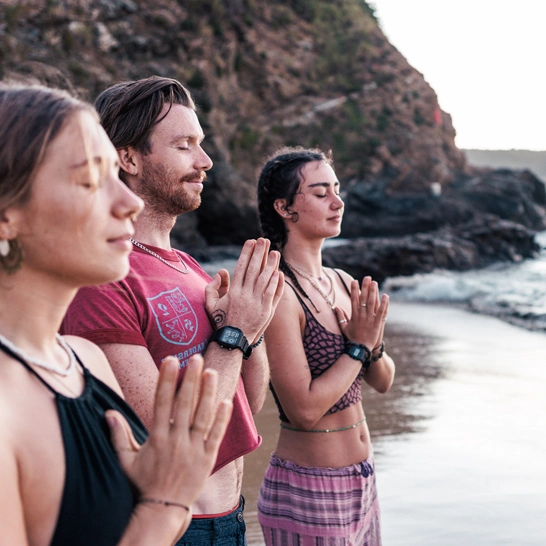
Whatever you call it, it’s that which calls you to look within.
Sign up for the Hridaya Newsletter to enliven your routine with exclusive, inspiring content that encourages you on the spiritual path.
This site is protected by reCAPTCHA and the Google Privacy Policy and Terms of Service apply.